eSIM for Guatemala 
Viasimo's Guatemala eSIM starts at $1.59 for 100 MB over 7 days, running on Claro with 4G LTE where available. Plans last 1 to 180 days, arrive by email in minutes and install from your phone's settings, with no app.
Works everywhere in Guatemala
- Alta Verapaz
- Baja Verapaz
- Chimaltenango
- Chiquimula
- El Progreso
- Escuintla
- Guatemala
Duration







Unlimited data · 3 Days ×1
$21.99
Does my phone take an eSIM? Check now
Dial *#06# on your phone. If you see an EID number, your phone takes an eSIM. Most phones sold since 2019 do.
Not sure it works on your phone? Check compatibilityWhich networks does the Guatemala eSIM use?
Host networks: Claro
Your eSIM picks one automatically; you do not choose or switch between them.
- Data
- 100 MB – 20 GB or unlimited
- Validity
- 1–180 days
- Speed
- 4G LTE
- Hotspot / tethering
- Supported on most devices
- Activation
- Automatic on arrival
- Speed management
- Roughly 2-3 GB per day at full speed, sometimes less depending on the local carrier, then reduced
- Top-ups
- Add more data from your account, before the plan expires
- Text messages (SMS)
- Data only: use an app for verification codes
- Connects via
- Belgium
- Unused validity
- 180 days before it must be installed
How much data do you need?
The allowances below are our sizing recommendations, not measurements. The plan beside each one is the cheapest option on this page that covers it.
| You are | Plan for | Cheapest plan that covers it |
|---|---|---|
| LightMaps, messaging and the occasional lookup | About 1 GB a week | $4.001 GB, 7 days |
| TypicalMaps, social, photos and some browsing | About 3 to 7 GB a week | $16.005 GB, 30 days |
| HeavyVideo streaming, video calls and uploads | 10 GB a week or more | $28.9910 GB, 30 days |
| Working or sharingTethering a laptop, calls and cloud sync | 20 GB a week or more | $47.99Unlimited, 7 days |
eSIM, local SIM or roaming?
Charged per day
Your carrier roaming
Queue and plastic
A SIM at the airport
$1.59
Viasimo, one bundle
Only the Viasimo figure is a price: it comes from today’s live catalog. The other two rows are directional, not quoted rates.
Important to know
- This is a data-only eSIM. It carries no calls or SMS on its own number.
- Your existing number stays on your primary SIM, so calls and verification texts keep working.
- Your phone must support eSIM, and some carrier-locked phones cannot install one.
- Signal varies with location, terrain, congestion and your handset. Dense urban areas are consistently better served than remote ones.
- The eSIM selects a host network automatically. You cannot pick or switch between them.
- Unlimited plans run at full speed up to a fair-use limit, then continue at a reduced speed. Read the fair usage policy
Frequently asked questions
Does an eSIM work in Guatemala?
Yes. Your Guatemala eSIM connects automatically the moment you arrive, with no roaming fees and nothing to set up at the airport. The host networks it can use are Claro. Coverage runs on 4G LTE. There is no 5G on our host network in Guatemala yet.
Do I get 5G in Guatemala?
No. Claro do not yet offer 5G to visitors in Guatemala, so your eSIM connects over 4G LTE or slower. Anyone claiming 5G for this destination is quoting a spec sheet, not the network you will actually get.
Does Movistar still exist in Guatemala?
No. Telefónica sold its Guatemalan operation to América Móvil, and it was merged into Claro, so Movistar no longer runs as a separate network. Guatemala's two main operators are now Claro and Tigo. This eSIM connects through Claro, so if your plan still mentions movistar, that refers to the network now operated by Claro.
What is the tourist emergency number in Guatemala?
Dial 1500 for PROATUR, INGUAT's 24-hour tourist assistance service. It can help after a crime and accompany you back to your hotel. The other numbers are 110 for police, 122 for the fire brigade and 123 for medical emergencies. Operators may not speak English. The eSIM is data only, so you'll need your home SIM for calls.
Is it safe to climb Acatenango while Fuego is erupting?
Only if the authorities allow it and you go with a reputable guide. Check INSIVUMEH and CONRED for restrictions on the day you go. The UK warns that tour organisers can underestimate the risks, that people have died, and that Guatemala has no mountain rescue service. Phone signal is unreliable above the forest line.
Can volcanic ash affect my flight from Guatemala City?
Yes. La Aurora International Airport can close at short notice when ash from active volcanoes such as Fuego or Pacaya drifts over the city. If there's an eruption close to your departure date, keep checking your airline's app and the news, and leave yourself a buffer before any connecting international flights.
Should I use Uber or a taxi in Guatemala City?
Use a ride-hailing app or a taxi arranged by your hotel. UK and Australian advice warns that express kidnappings often begin with taxis hailed on the street or taken from ranks. A booked ride records your driver and route. You'll need mobile data, so have your eSIM working before you leave La Aurora airport.
How much data do I need for 7 days in Guatemala?
For 7 days in Guatemala, Viasimo sells 100 MB for $1.59, 1 GB for $4.00, and unlimited data for $47.99. Our sizing recommendation, not a measurement: maps, messaging and the occasional lookup, about 1 GB a week; maps, social, photos and some browsing, about 3 to 7 GB a week. The data calculator on this site works it out from how you actually use your phone.
Installing, keeping your number, topping up and hotspot work the same everywhere: see how it works →
Guatemala: what to know before you land
Guatemala now has two main mobile networks, Claro and Tigo, since Movistar's local business was absorbed into Claro. This eSIM uses Claro. Before you go, save the 24-hour PROATUR tourist assistance number, 1500, and check volcano alerts before climbing Acatenango or Pacaya, because ash from Fuego can close La Aurora airport at short notice.
- Emergency
-
- 1500 PROATUR tourist assistance
- 110 police
- 122 fire
- 123 medical
- Plugs
- AB 120V
- Currency
- Guatemalan quetzal (GTQ)
Main airports
- GUA La Aurora International Airport, Guatemala City
- FRS Mundo Maya International Airport, Flores
Claro, Tigo and the end of Movistar in Guatemala
Older guides list three mobile networks in Guatemala: Claro, Tigo and Movistar. That is out of date. Telefónica sold its Guatemalan business to América Móvil, the owner of Claro, and the two were merged. Movistar no longer operates as a separate network in Guatemala, so you'll see Claro on your phone.
That leaves two large networks, Claro and Tigo (owned by Millicom). Your eSIM connects through Claro and does not use Tigo. Where Claro has switched on 5G and your phone supports it, you'll use it. Elsewhere you'll be on 4G, falling back to 3G in the highlands and Petén.
In practice, if a guide or shuttle driver on Tigo has a signal in a village where you don't, that is the reason. Ask them to send messages for you or share their hotspot. If your plan lists "movistar" as one of its networks, treat it as part of Claro.
Fuego, Pacaya and Acatenango: check INSIVUMEH and CONRED first
Volcán de Fuego, Pacaya and Santiaguito are all very active, and activity can increase without warning. Before any hike, the UK Foreign Office recommends checking INSIVUMEH, the national meteorology and volcanology institute, and CONRED, the disaster agency, for access restrictions and current recommendations. Do this on the morning you set off, not when you booked.
The UK says local tour operators may underestimate the risks, deaths have occurred on volcano hikes, and there is no mountain rescue service. Once you're above the forest on Acatenango, you may not have a signal, so tell someone at your accommodation when you expect to be back.
Ash can also affect your flights. La Aurora International Airport in Guatemala City can close at short notice because of volcanic ash, so if Fuego is erupting near your departure date, keep checking your airline's app. If ash is falling, Australian advice is to wear a disposable mask, goggles and long clothing, and people with respiratory conditions should take particular care.
PROATUR 1500 and the emergency numbers to save
Guatemala uses several emergency numbers, so save these before you arrive:
- 1500: PROATUR, the 24-hour tourist assistance service run by INGUAT. It can also escort victims of crime back to their hotel or another safe place. Its email address is proatur@inguat.gob.gt.
- 110: National Police.
- 122: Fire brigade, also for rescue.
- 123: Medical emergencies, and an alternative fire brigade number.
- 1520: PROVIAL roadside assistance, although patrols are infrequent.
Emergency operators may not speak English. Keep a few Spanish phrases and your accommodation's address saved in your translation app so you can read them out. Your eSIM is data only, so to make calls use your home SIM (roaming charges may apply), or use WhatsApp to contact your hotel or tour company and ask them to call for you. PROATUR's email is a useful backup if you have data but can't get through by phone.
Ride-hailing, ATMs and keeping your phone safe in Guatemala City
Australian and UK advice both recommend using a ride-hailing app in Guatemala City and Antigua instead of hailing a taxi on the street or picking one up at a rank. Express kidnappings, where victims are driven around and forced to withdraw cash, often begin in a taxi flagged down on the street. A booked ride means your driver, car and route are recorded on your phone. Book in advance if you're travelling after dark.
Keep your phone out of sight in public. Phone snatching is common at ATMs, petrol stations, bus terminals, shopping centres and the airport. Use ATMs inside banks or hotels, check them for tampering, and withdraw modest amounts. You can't bring quetzales into or out of Guatemala, and US dollars are the only foreign currency you can exchange, so bring dollars as a backup.
Avoid public wifi and Bluetooth for banking, and use your eSIM data instead. If you're taking a boat on the Río Dulce or to Livingston, ask about security first, as boats there have been targeted by criminals. Be careful what you post on social media too, as people have been arrested over online posts.
Researched October 2026 · 5 sources
- gov.uk Guatemala travel advice: safety and security (GOV.UK)
- smartraveller.gov.au Guatemala travel advice (Smartraveller)
- en.wikipedia.org Movistar (Wikipedia)
- en.wikipedia.org Telecommunications in Guatemala (Wikipedia)
- worldstandards.eu Plug, socket and voltage by country (World Standards)
Seven days in Guatemala: Antigua, Lake Atitlán, Chichicastenango and Tikal
The classic first week in Guatemala: colonial Antigua under its volcanoes, the Maya villages around Lake Atitlán, the market at Chichicastenango, then a flight north to Flores for the jungle ruins of Yaxhá and Tikal.
When to go November to April is the dry season and the easiest time for volcano views and Tikal; Semana Santa in Antigua is spectacular but very busy, and May to October brings afternoon rain.
-
Day 1 Antigua Guatemala
Antigua: arches, churches and Cerro de la Cruz
La Aurora Airport to Antigua is about 45 km, 1 to 1 hour 30 minutes by pre-booked shuttle or ride-hailing app depending on traffic.
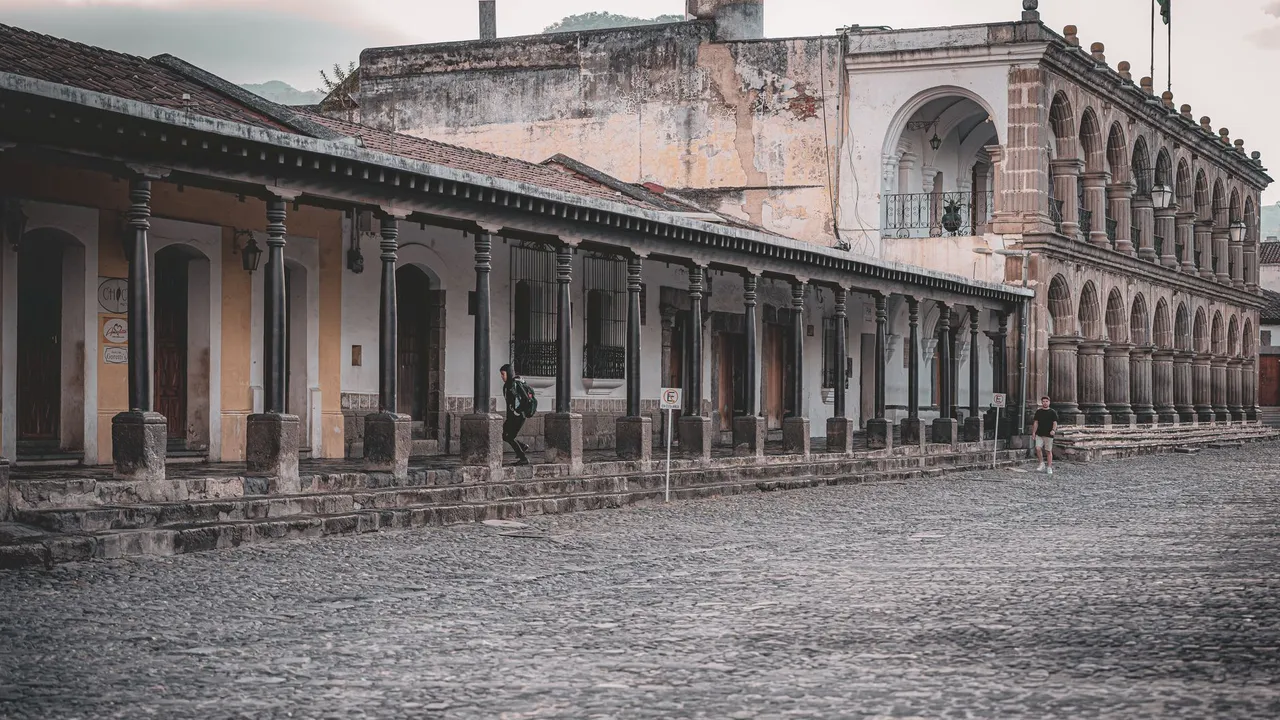
Transfer from the airport to Antigua, the UNESCO-listed former capital. Walk the cobbled grid from the Parque Central past the cathedral to the Santa Catalina Arch, with Volcán de Agua framed behind it, and on to the yellow church of La Merced. In the late afternoon, climb the stairs to Cerro de la Cruz for the view over the town, going with others or a tourist police escort.
Signal Claro 4G covers Guatemala City and Antigua well, with 5G in parts of the capital. Keep your phone out of sight on the street, where snatching is common.
-
Day 2 Antigua Guatemala
Pacaya volcano and Antigua's ruins
Pacaya trailhead at San Francisco de Sales is about 1 hour 30 minutes from Antigua by tour shuttle.
Check INSIVUMEH and CONRED for restrictions, then take a morning guided hike up Pacaya, an active volcano with lava fields about 1 hour 30 minutes from Antigua. Back in town, explore the earthquake-damaged colonial buildings: the Capuchinas convent with its circular cloister, the church of San Francisco el Grande, and the ruined cathedral behind the facade on the square. If Pacaya is closed, visit a coffee farm on the slopes of Agua instead.
Signal 4G is usually available on the lower slopes of Pacaya and at the trailhead, but can drop higher up. In Antigua, thick colonial walls weaken it indoors.
-
Day 3 Panajachel
To Lake Atitlán
Antigua to Panajachel is about 2 hours 30 minutes to 3 hours by tourist shuttle.
Take a shuttle west through the highlands to Panajachel on the shore of Lake Atitlán, a large crater lake ringed by the San Pedro, Tolimán and Atitlán volcanoes. In the afternoon, take a public boat across to Santa Cruz La Laguna and walk the steep lanes for views back across the water. Return to Panajachel and walk Calle Santander, the main street down to the lake.
Signal 4G along most of the Inter-American Highway, with gaps on the descent to Sololá. Panajachel has good Claro coverage; it is weaker on the water and in Santa Cruz.
-
Day 4 Panajachel
San Juan, San Pedro and Santiago Atitlán
Public lanchas link the villages every 30 minutes or so in daylight; each crossing takes 15 to 30 minutes.
Spend the day hopping by lancha between lake villages. Start in San Juan La Laguna to visit the women's weaving cooperatives, which dye cotton with natural plants, then walk to neighbouring San Pedro La Laguna. Cross to Santiago Atitlán, the largest Tz'utujil Maya town, to see its colonial church and visit the house shrine of Maximón, a folk saint, with a local guide. Take the last boats back well before dusk.
Signal The larger villages have 4G or 3G, but signal comes and goes on the boats and below the steep shores. Save the boat times and your accommodation's WhatsApp number.
-
Day 5 Guatemala City
Chichicastenango market
Panajachel to Chichicastenango is about 1 hour 30 minutes; Chichicastenango to Guatemala City is about 3 hours by shuttle.
Go on a Thursday or Sunday to the market at Chichicastenango, where traders from the highlands fill the streets with textiles, masks and produce. Visit the church of Santo Tomás, where K'iche' Maya ritual and Catholic worship meet on the steps, and the hilltop shrine of Pascual Abaj if a guide is available. In the afternoon, travel on to Guatemala City to be ready for tomorrow's flight north.
Signal 4G in Chichicastenango, though the market crowds slow data. The mountain roads between towns have patchy coverage.
-
Day 6 Flores
Fly to Flores and sunset at Yaxhá
Guatemala City to Flores is about a 1-hour flight. Yaxhá is around 1 hour 30 minutes from Flores by road.
Take a morning flight to Flores in Petén. Walk the small island town of Flores on Lake Petén Itzá, joined to the mainland by a causeway. In the afternoon, take a tour to Yaxhá, a large Maya city between two lagoons that sees far fewer visitors than Tikal, and climb Temple 216 for sunset over the forest. Return to Flores after dark with your guide.
Signal 4G in Flores and Santa Elena. At Yaxhá there is little or no signal, so download your tour details and offline maps first.
-
Day 7 Flores
Tikal at dawn
Tikal is about 1 hour 15 minutes from Flores by shuttle or tour.
Leave very early for Tikal National Park, a UNESCO site where temples rise above the rainforest canopy. Walk the Gran Plaza between Temples I and II, climb the wooden stairs to the top of Temple IV, and visit the Mundo Perdido complex. Listen for howler monkeys and look for toucans and coatis along the trails. Return to Flores airport for an afternoon flight back to Guatemala City.
Signal Expect a weak signal near the visitor centre and none deep in the park. Download the site map and arrange a meeting time with your driver in advance.
Staying connected on this route
- Your eSIM uses Claro only; Movistar has merged into Claro, and Tigo is not used, so a Tigo user may have signal where you do not.
- Check INSIVUMEH and CONRED on the morning of any volcano hike, and watch your airline app if Fuego is erupting near your flight.
- Save PROATUR, the 24-hour tourist assistance line on 1500, and remember the eSIM is data only: call from your home SIM or ask your hotel via WhatsApp.
- Use a ride-hailing app or hotel taxi in Guatemala City and Antigua rather than hailing one on the street.
Itinerary sources · 6
- gov.uk GOV.UK foreign travel advice: Guatemala warnings and insurance
- gov.uk GOV.UK: Guatemala safety and security
- whc.unesco.org UNESCO World Heritage: Antigua Guatemala
- whc.unesco.org UNESCO World Heritage: Tikal National Park
- insivumeh.gob.gt INSIVUMEH: volcanology bulletins
- smartraveller.gov.au Smartraveller: Guatemala
Information and verification
Each block below says what was checked and when. Anything we cannot date, we do not claim.
- Prices and plans
- Every price and allowance on this page is read from the live catalog, not typed in.
- Host networks
- The operator list comes from the network partner that carries this eSIM.
Guatemala eSIM prices
| Data | Price | Per day |
|---|---|---|
| Unlimited | $21.99 | $7.33/day |
| Data | Price | Per day |
|---|---|---|
| Unlimited | $34.00 | $6.80/day |
| Data | Price | Per day |
|---|---|---|
| 100 MBBest value | $1.59 | $0.23/day |
| 1 GB | $4.00 | $0.57/day |
| Unlimited | $47.99 | $6.86/day |
| Data | Price | Per day |
|---|---|---|
| Unlimited | $64.99 | $6.50/day |
| Data | Price | Per day |
|---|---|---|
| Unlimited | $359.99 | $6.00/day |
| Data | Price | Per day |
|---|---|---|
| Unlimited | $534.99 | $5.94/day |
| Data | Price | Per day |
|---|---|---|
| Unlimited | $1,069.99 | $5.94/day |
Going to more than one country?
Regional plans that also cover Guatemala


Destinations