eSIM for El Salvador 
Viasimo's El Salvador eSIM starts at $1.59 for 100 MB over 7 days, running on Claro and movistar with 4G LTE where available. Plans last 3 to 180 days, arrive by email in minutes and install from your phone's settings, with no app.
Works everywhere in El Salvador
- Ahuachapan
- Cabanas
- Chalatenango Department
- Cuscatlan
- La Libertad Department
- La Paz Department
- La Union
Duration







Unlimited data · 3 Days ×1
$39.99
Does my phone take an eSIM? Check now
Dial *#06# on your phone. If you see an EID number, your phone takes an eSIM. Most phones sold since 2019 do.
Not sure it works on your phone? Check compatibilityWhich networks does the El Salvador eSIM use?
Host networks: Claro / movistar
Your eSIM picks one automatically; you do not choose or switch between them.
- Data
- 100 MB – 5 GB or unlimited
- Validity
- 3–180 days
- Speed
- 4G LTE
- Hotspot / tethering
- Supported on most devices
- Activation
- Automatic on arrival
- Speed management
- Roughly 2-3 GB per day at full speed, sometimes less depending on the local carrier, then reduced
- Top-ups
- Add more data from your account, before the plan expires
- Text messages (SMS)
- Data only: use an app for verification codes
- Connects via
- Belgium
- Unused validity
- 180 days before it must be installed
How much data do you need?
The allowances below are our sizing recommendations, not measurements. The plan beside each one is the cheapest option on this page that covers it.
| You are | Plan for | Cheapest plan that covers it |
|---|---|---|
| LightMaps, messaging and the occasional lookup | About 1 GB a week | $3.791 GB, 7 days |
| TypicalMaps, social, photos and some browsing | About 3 to 7 GB a week | $21.995 GB, 30 days |
| HeavyVideo streaming, video calls and uploads | 10 GB a week or more | $86.99Unlimited, 7 days |
| Working or sharingTethering a laptop, calls and cloud sync | 20 GB a week or more | $86.99Unlimited, 7 days |
eSIM, local SIM or roaming?
Charged per day
Your carrier roaming
Queue and plastic
A SIM at the airport
$1.59
Viasimo, one bundle
Only the Viasimo figure is a price: it comes from today’s live catalog. The other two rows are directional, not quoted rates.
Important to know
- This is a data-only eSIM. It carries no calls or SMS on its own number.
- Your existing number stays on your primary SIM, so calls and verification texts keep working.
- Your phone must support eSIM, and some carrier-locked phones cannot install one.
- Signal varies with location, terrain, congestion and your handset. Dense urban areas are consistently better served than remote ones.
- The eSIM selects a host network automatically. You cannot pick or switch between them.
- Unlimited plans run at full speed up to a fair-use limit, then continue at a reduced speed. Read the fair usage policy
Frequently asked questions
Does an eSIM work in El Salvador?
Yes. Your El Salvador eSIM connects automatically the moment you arrive, with no roaming fees and nothing to set up at the airport. The host networks it can use are Claro, movistar. Coverage runs on 4G LTE. There is no 5G on our host network in El Salvador yet.
Do I get 5G in El Salvador?
No. Claro, movistar do not yet offer 5G to visitors in El Salvador, so your eSIM connects over 4G LTE or slower. Anyone claiming 5G for this destination is quoting a spec sheet, not the network you will actually get.
Do I have to pay with bitcoin in El Salvador?
No. Since the Bitcoin Law was amended in early 2025 under an IMF agreement, businesses are no longer required to accept bitcoin, and the government is winding down its Chivo wallet. The US dollar is the official currency. Cards work in larger businesses, but carry cash, because some places don't take cards and ATMs are often out of order.
How far is San Salvador from the airport?
About 50 km. Saint Óscar Arnulfo Romero International Airport (SAL) is in San Luis Talpa, linked to the capital by a four-lane motorway. It is closer to the surf towns around La Libertad, El Tunco and El Zonte, so many surfers head straight to the coast and never stay in San Salvador at all.
Will my El Salvador eSIM work in Guatemala or Honduras?
No. The plan covers El Salvador only, so data stops when you cross the border. The CA-4 agreement means one 90-day immigration allowance covers El Salvador, Guatemala, Honduras and Nicaragua together, but that applies to your passport, not your phone. Add a plan for each country before you cross.
Is it safe to use my phone in public in El Salvador?
The country is rated Level 1 by the US State Department, but it still advises against using phones and earphones in public because they distract you from your surroundings. Use your phone discreetly, keep a copy of your passport with you because of the ongoing state of exception, and share your live location with someone you trust when travelling between towns.
How much data do I need for 7 days in El Salvador?
For 7 days in El Salvador, Viasimo sells 100 MB for $1.59, 500 MB for $2.79, 1 GB for $3.79, and unlimited data for $86.99. Our sizing recommendation, not a measurement: maps, messaging and the occasional lookup, about 1 GB a week; maps, social, photos and some browsing, about 3 to 7 GB a week. The data calculator on this site works it out from how you actually use your phone.
Installing, keeping your number, topping up and hotspot work the same everywhere: see how it works →
El Salvador: what to know before you land
El Salvador uses the US dollar, and since a 2025 law change businesses no longer have to accept bitcoin, so a card plus cash is what you will actually spend. Your eSIM runs on Claro's 4G. You land at Monseñor Romero International (SAL), around 50 km from San Salvador, and entry also covers Guatemala, Honduras and Nicaragua under the CA-4 agreement.
- Emergency
-
- 911 police
- 132 ambulance
- 913 fire
- Plugs
- AB 120V
- Currency
- US dollar (USD)
Main airports
- SAL Saint Óscar Arnulfo Romero y Galdámez International Airport
Arriving at Monseñor Romero International (SAL)
The country's international airport is officially Saint Óscar Arnulfo Romero y Galdámez International Airport (SAL). It sits in San Luis Talpa in La Paz department, about 50 km by four-lane motorway from San Salvador, and much closer to the surf towns of La Libertad. A new terminal opened in February 2022, with arriving, connecting and departing passengers kept in separate areas.
A few entry points to know:
- Many nationalities, including US citizens, need no visa for stays of up to 90 days.
- El Salvador belongs to the CA-4 agreement with Guatemala, Honduras and Nicaragua. That 90 days is a combined allowance across all four countries, not 90 days in each, and being expelled from one means removal from the whole region.
- You can carry up to US$10,000 in cash in or out without declaring it.
If you are travelling on to Guatemala or Honduras, remember that your El Salvador eSIM works only inside El Salvador, so add a plan for each country you are crossing into.
Bitcoin after the 2025 reform: US dollars still rule
El Salvador became famous in 2021 for making bitcoin legal tender. That experiment has largely been reversed. Under an agreement with the IMF in December 2024, the government amended the Bitcoin Law in early 2025: businesses are no longer required to accept bitcoin, taxes can't be paid in it, and the state agreed to wind down its involvement in the Chivo wallet. Surveys found that only about 8 percent of Salvadorans were using bitcoin for transactions by 2024.
Some cafés and hostels around El Zonte, the beach town that promoted itself as Bitcoin Beach, may still take crypto, but don't plan your budget around it.
The US dollar is the official currency and what everyone uses. The US State Department notes that some businesses don't accept cards or add a fee for them, and that ATMs, while usually compatible with foreign cards, are often out of order or charge high fees. Take out cash in San Salvador or Santa Ana before you head to the coast or the highlands, and carry smaller notes for pupuserías, buses and tips.
Your phone and El Salvador's state of exception
El Salvador has been under a state of exception since March 2022, as part of its crackdown on gangs. The US State Department rates the country Level 1, exercise normal precautions, but explains that while it lasts, the authorities can detain anyone they suspect of gang links, with no written criteria for what counts, and some constitutional rights, such as access to a lawyer and a speedy trial, are suspended. Several US citizens have been held without trial.
In practice, most visitors notice little more than police and military patrols. Some sensible habits:
- Keep your passport, or a copy, with you, along with a screenshot of your accommodation booking.
- Share your live location with someone you trust when you travel between towns, which is easy with mobile data.
- Don't walk along staring at your phone in busy places. The State Department specifically advises against using phones and earphones in public because they make you less aware of your surroundings.
- Carry a way to charge your phone, and have more than one way to get in touch, such as WhatsApp plus a normal phone call on your home SIM.
US citizens can sign up to STEP for embassy alerts.
Surf safety at El Tunco, El Zonte and El Cuco
El Salvador's Pacific beaches are the reason many people come, and they are more dangerous than they look. The State Department warns of strong currents and undertows that can catch out experienced swimmers. Follow lifeguards' instructions where there are any, stay out when red or black flags are flying, and take extra care on the many beaches with no lifeguard or flags at all. Waterfalls and crater lakes have their own hazards, and help can take a long time to arrive.
Before you paddle out, save the local emergency numbers in your phone: 911 for police and 132 for an ambulance. Tell your hostel or surf school when you expect to be back, and leave your phone somewhere safe and dry rather than in an unattended car or on the sand.
If you're travelling between the coast and San Salvador after dark, the airport road and the motorway to La Libertad are the main routes. US government staff are allowed to use those routes at any hour, but are restricted to daylight on other intercity roads, which is a good guide for your own planning.
Researched October 2026 · 4 sources
- travel.state.gov El Salvador International Travel Information (US State Department)
- en.wikipedia.org Bitcoin in El Salvador (Wikipedia)
- en.wikipedia.org El Salvador International Airport (Wikipedia)
- worldstandards.eu Plug, socket and voltage by country (World Standards)
Seven days in El Salvador: El Tunco, San Salvador, Suchitoto, Santa Ana and the Ruta de las Flores
A compact loop that suits a small country: start on the surf coast near the airport, then the capital and its volcano, colonial Suchitoto, the Maya sites and Santa Ana volcano in the west, ending in the coffee towns of the Ruta de las Flores.
When to go The dry season from November to April gives clear volcano views and easier hiking; May to October is the rainy season, with afternoon downpours but the biggest, most consistent surf.
-
Day 1 El Tunco
Arrive and head to El Tunco
About 30 to 40 minutes by road from Monseñor Romero International (SAL).
From the airport, drive west along the coast road to El Tunco, the small surf town named after the pig-shaped rock off its beach. Walk the beach at low tide, watch surfers on the point break, and stay for sunset behind the rock. Swim only where locals do and never when red flags are flying, because the Pacific undertow here is strong.
Signal Claro 4G covers the airport, the coast road and El Tunco well, so you can message your accommodation as soon as you land.
-
Day 2 El Tunco
Surf lesson, El Zonte and Surf City
Book an early surf lesson when the wind is calm, or rent a board if you already surf. Later, drive along the coast to El Zonte, the beach village that promoted itself as Bitcoin Beach, then back to the Puerto de La Libertad seafront, the redeveloped malecón of the government's Surf City programme, for the pier and fish market.
Signal 4G is reliable along the coastal highway and in El Tunco, El Zonte and La Libertad; leave the phone dry and locked away while you are in the water.
-
Day 3 San Salvador
San Salvador and El Boquerón
About 45 minutes from El Tunco to San Salvador by road.
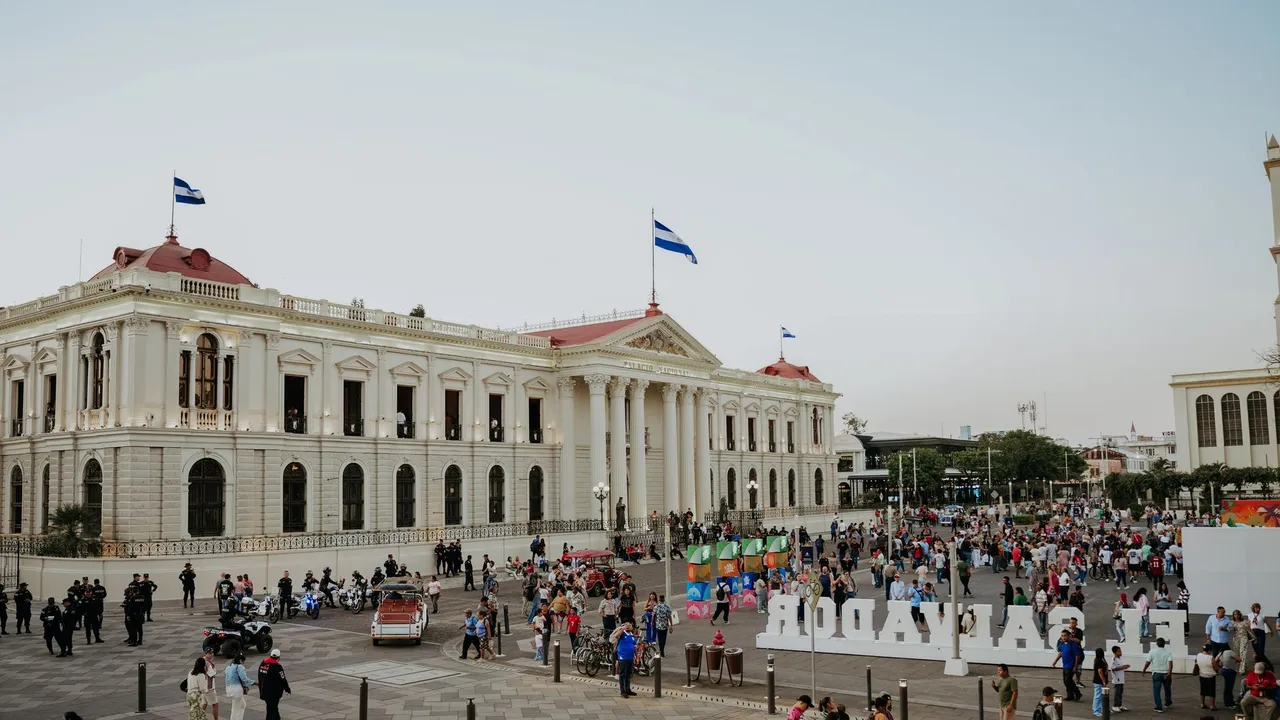
Drive up to the capital. In the historic centre, visit the Metropolitan Cathedral and the crypt of Saint Óscar Romero, the National Palace and the National Theatre, then the modernist Iglesia El Rosario with its coloured-glass light. In the afternoon, drive up to El Boquerón National Park to walk the short trail around the rim of the San Salvador volcano's crater.
Signal Strong Claro 4G across San Salvador; up at El Boquerón the signal stays usable on the crater rim. Use your phone discreetly in the busy centre.
-
Day 4 Suchitoto
Suchitoto and Lake Suchitlán
About 1 hour 15 minutes by road from San Salvador.
Head north to Suchitoto, a hillside colonial town of cobbled streets and whitewashed houses. Visit the Santa Lucía church on the main square and wander the side streets of craft shops and galleries. In the afternoon, take a boat trip on Lake Suchitlán, the reservoir below the town, to see the birdlife, or walk to the Los Tercios waterfall of hexagonal basalt columns.
Signal Claro 4G works in Suchitoto town; on the lake and at Los Tercios the signal weakens, but you can usually still send messages.
-
Day 5 Santa Ana
Joya de Cerén, Tazumal and Santa Ana
About 1.5 hours from Suchitoto to Joya de Cerén, then around 45 minutes on to Chalchuapa and Santa Ana.
Drive west to Joya de Cerén, the UNESCO-listed Maya farming village buried by volcanic ash around 1,400 years ago, which preserves everyday houses rather than temples. Continue to Tazumal in Chalchuapa, the country's best-known Maya pyramid complex, and its small museum. End in Santa Ana, El Salvador's second city, to see the neo-Gothic cathedral and the National Theatre on the main square.
Signal Good 4G along the main highways and in Santa Ana; the archaeological sites are close to towns and also covered.
-
Day 6 Juayúa
Santa Ana volcano and Lake Coatepeque
About an hour from Santa Ana to Cerro Verde; check the hike's departure time locally, as it runs once a day with a guide.
Drive to Cerro Verde National Park and join the guided group hike up Santa Ana volcano, or Ilamatepec, the country's highest volcano, to look into the crater with its sulphurous green lake. The return trip takes around four hours. Afterwards, stop at a viewpoint over Lake Coatepeque, the blue crater lake below, then drive on to Juayúa for the night.
Signal 4G is patchy on the forested lower trail and often returns on the exposed upper slopes and crater rim; Juayúa has 4G in town.
-
Day 7 Juayúa
Ruta de las Flores and back to the airport
Allow around 2 hours from Ataco to the airport; avoid driving after dark.
Explore the Ruta de las Flores, the mountain road of coffee towns. In Juayúa, see the church of the Black Christ; if it is a weekend, browse the food festival. Drive to Apaneca, then to Concepción de Ataco for its painted murals and a coffee farm tour. Leave by mid-afternoon to reach the airport in daylight.
Signal 4G holds in the towns along the route but drops on some bends between Apaneca and Ataco; the motorway to the airport is well covered.
Staying connected on this route
- Share your live location with someone you trust on the days you drive between towns.
- Download offline maps of the west, including Cerro Verde and the Ruta de las Flores, before leaving Santa Ana.
- Your eSIM covers El Salvador only: add a plan before crossing into Guatemala or Honduras, even though the CA-4 visa allowance is shared.
Itinerary sources · 4
- en.wikivoyage.org El Salvador (Wikivoyage)
- gov.uk El Salvador safety and security (GOV.UK)
- whc.unesco.org Joya de Cerén Archaeological Site (UNESCO)
- travel.state.gov El Salvador International Travel Information (US State Department)
Information and verification
Each block below says what was checked and when. Anything we cannot date, we do not claim.
- Prices and plans
- Every price and allowance on this page is read from the live catalog, not typed in.
- Host networks
- The operator list comes from the network partner that carries this eSIM.
El Salvador eSIM prices
| Data | Price | Per day |
|---|---|---|
| Unlimited | $39.99 | $13.33/day |
| Data | Price | Per day |
|---|---|---|
| Unlimited | $62.99 | $12.60/day |
| Data | Price | Per day |
|---|---|---|
| 100 MBBest value | $1.59 | $0.23/day |
| 500 MB | $2.79 | $0.40/day |
| 1 GB | $3.79 | $0.54/day |
| Unlimited | $86.99 | $12.43/day |
| Data | Price | Per day |
|---|---|---|
| Unlimited | $119.99 | $12.00/day |
| Data | Price | Per day |
|---|---|---|
| Unlimited | $184.99 | $12.33/day |
| Data | Price | Per day |
|---|---|---|
| Unlimited | $654.99 | $10.92/day |
| Data | Price | Per day |
|---|---|---|
| Unlimited | $984.99 | $10.94/day |
| Data | Price | Per day |
|---|---|---|
| Unlimited | $1,959.99 | $10.89/day |
Going to more than one country?
Regional plans that also cover El Salvador


Destinations