★★★★★5 out of 5Zimbabve’de çok iyi çalıştı
Zimbabve seyahatimde kullandım, gerçekten çok memnun kaldım. eSIM’i kurmak çok kolaydı ve internet bağlantısı gayet hızlıydı. Hiçbir sorun yaşamadım, kesinlikle tekrar kullanırım.

Viasimo's Zimbabwe eSIM starts at $4.00 for 1 GB over 7 days, running on Econet with 4G LTE where available. Plans last 3 to 180 days, arrive by email in minutes and install from your phone's settings, with no app.
Duration







Unlimited data · 3 Days ×1
$21.99
Dial *#06# on your phone. If you see an EID number, your phone takes an eSIM. Most phones sold since 2019 do.
Not sure it works on your phone? Check compatibilityHost networks: Econet
Your eSIM picks one automatically; you do not choose or switch between them.
The allowances below are our sizing recommendations, not measurements. The plan beside each one is the cheapest option on this page that covers it.
| You are | Plan for | Cheapest plan that covers it |
|---|---|---|
| LightMaps, messaging and the occasional lookup | About 1 GB a week | $4.001 GB, 7 days |
| TypicalMaps, social, photos and some browsing | About 3 to 7 GB a week | $16.005 GB, 30 days |
| HeavyVideo streaming, video calls and uploads | 10 GB a week or more | $28.9910 GB, 30 days |
| Working or sharingTethering a laptop, calls and cloud sync | 20 GB a week or more | $47.00Unlimited, 7 days |
Charged per day
Your carrier roaming
Queue and plastic
A SIM at the airport
$4.00
Viasimo, one bundle
Only the Viasimo figure is a price: it comes from today’s live catalog. The other two rows are directional, not quoted rates.
5.0 out of 5 from 2 reviews
★★★★★5 out of 5Zimbabve’de çok iyi çalıştı
Zimbabve seyahatimde kullandım, gerçekten çok memnun kaldım. eSIM’i kurmak çok kolaydı ve internet bağlantısı gayet hızlıydı. Hiçbir sorun yaşamadım, kesinlikle tekrar kullanırım.
★★★★★5 out of 5Great experience
Used this on my trip and it worked really well. Setup was super easy and the connection was fast and reliable wherever I went. No issues at all, would definitely use it again if i ever travel to this place again or a different place.
Yes. Your Zimbabwe eSIM connects automatically the moment you arrive, with no roaming fees and nothing to set up at the airport. The host networks it can use are Econet. Coverage runs on 4G LTE. There is no 5G on our host network in Zimbabwe yet.
No. Econet do not yet offer 5G to visitors in Zimbabwe, so your eSIM connects over 4G LTE or slower. Anyone claiming 5G for this destination is quoting a spec sheet, not the network you will actually get.
This eSIM connects to Econet on 4G/LTE. Econet began operating in 1998, launched 3G in 2007, and by 2025 had about 11.8 million mobile subscriptions and more than 70% of the market. Other operators include NetOne, which the eSIM doesn't use. UK advice describes Zimbabwe's networks as unreliable, so expect some gaps.
Not once your phone connects to a Zambian network. A Zimbabwe-only plan works on Econet in Zimbabwe only. If you buy a KAZA Univisa (US$50, valid 30 days, covering Zimbabwe, Zambia and day trips to Botswana), you'll need a plan for each country you visit. Turn the Zimbabwe line off before crossing the bridge.
Often not. The UK Foreign Office says US dollar notes are in short supply, so international cards may not work at ATMs. The US dollar is legal tender alongside the ZiG, which was introduced in April 2024. Bring enough small, undamaged dollar notes, exchange money only with licensed dealers, and don't leave the country with more than US$2,000 in cash.
UK government advice lists 112 for police, ambulance and fire, which is also the emergency number for Econet mobile users. From a NetOne mobile, call 114, and from a landline 0800 3222 911. The eSIM is data only, so call from your home SIM or a lodge phone, and keep your lodge's own number saved.
The UK Foreign Office advises against using GPS navigation around State House in Harare, where photography is illegal and roads close from 6pm to 6am. Plan your route around the area before you set off. Photographing police, soldiers, protests or government buildings without permission is also illegal and strictly enforced.
For 7 days in Zimbabwe, Viasimo sells 1 GB for $4.00 and unlimited data for $47.00. Our sizing recommendation, not a measurement: maps, messaging and the occasional lookup, about 1 GB a week; maps, social, photos and some browsing, about 3 to 7 GB a week. The data calculator on this site works it out from how you actually use your phone.
Installing, keeping your number, topping up and hotspot work the same everywhere: see how it works →
In Zimbabwe your eSIM uses Econet, which has more than 70% of the country's mobile subscribers, on 4G/LTE. The bigger practical challenges are long, frequent power cuts, a shortage of US dollar cash that stops many foreign cards working at ATMs, and strict rules on photographing officials and posting about politics.
Main airports
The UK Foreign Office warns that power cuts are frequent and sometimes long, and that traffic lights may stop working during them. Some areas also ration water, so check with your hotel or tour operator about local conditions.
This affects your phone more than you might expect. Hotel sockets may not work for hours at a time, and mobile masts need electricity too, so the signal can drop at the same moment your battery is running down. Charge your phone and a power bank whenever the power is on, especially overnight. If you're driving, bring a car charger. Download your maps and bookings before you leave, rather than counting on wifi or a signal when you arrive somewhere.
Fuel can be hard to find too. The FCDO says it isn't always available and there may be queues, so carry extra fuel and fill up whenever you can. Before a long drive, for example from Bulawayo to Hwange or from Harare towards Mana Pools, ask your lodge on WhatsApp which towns on your route have fuel, and leave with a full tank.
Zimbabwe introduced a new currency, the ZiG (Zimbabwe Gold), in April 2024. The US dollar is still legal tender and is used for most transactions. Physical dollar notes are in short supply, though, and the FCDO warns that international cards may not work at ATMs. Many businesses, including some medical providers, prefer cash.
In practice, this means:
In 2017 Econet's EcoCash had almost the entire mobile money market. It needs a local Econet line registered in your name, so you can't use it with a travel eSIM. Use your eSIM data to confirm in advance by message which payment methods each lodge or operator accepts.
Police roadblocks are common. Stop when signalled, carry copies of your passport photo page and visa (photos on your phone are useful as a backup), and ask for a receipt for any fine you pay. If the President's motorcade passes, you must pull over as soon as it's safe. It's illegal to keep driving.
Phone use in Harare needs care. Around State House, photography is illegal and the roads close from 6pm to 6am. The FCDO advises not using GPS navigation in that area. Elsewhere, you need permission from the Ministry of Information to photograph government offices, airports, military sites or embassies. Photographing police, the armed forces, demonstrations or protests is illegal and strictly enforced.
On the road, smash-and-grab robberies have happened on several routes, including the airport road and the Masvingo–Beitbridge road. Keep your phone out of sight and your doors locked. Avoid driving outside the main towns after dark, because of potholes, unlit vehicles and livestock on the road, and because ambulances may not be reliable.
According to UK government advice, 112 connects you to the police, ambulance and fire services and is also the emergency number for Econet mobile subscribers. NetOne subscribers use 114, and from a landline the number is 0800 3222 911. Your eSIM is data only, so make emergency calls from your home SIM or a lodge phone. Save your lodge's and operator's numbers as well, because emergency services can be slow to respond outside the cities.
Be careful what you post. Making derogatory or insulting comments about the President is illegal in Zimbabwe, and the authorities define journalism broadly: it can include interviews, filming and photography, and doing it without accreditation is an offence. The FCDO advises avoiding political discussions in public, including online, and staying away from demonstrations, which can turn violent.
Wait until you've left the country before posting photos of anything sensitive. Keep comments about local politics off your social media for the length of your trip.
A western Zimbabwe week for first-time visitors: two days at Victoria Falls, two days of game drives in Hwange National Park, then Bulawayo, the granite kopjes and rock art of Matobo, and the Khami ruins before flying out.
When to go May to October is the dry season and best for game viewing in Hwange; the falls are fullest from March to May with heavy spray, and lowest from October to December, when the heat builds before the rains.
Day 1 Victoria Falls
Victoria Falls Airport is about 20 km from town, around 25 minutes by pre-booked transfer.
Walk the paths through the rainforest opposite Victoria Falls, Mosi-oa-Tunya, a UNESCO site shared with Zambia. Follow the numbered viewpoints from the Devil's Cataract and the statue of David Livingstone to Main Falls and Danger Point, with a raincoat if you visit between March and June, when the spray is heaviest. In the evening, walk through Victoria Falls town or watch the sunset from a viewpoint above the Batoka Gorge.
Signal Econet 4G in Victoria Falls town and at the falls entrance; spray and the gorge can make the signal patchy at the far viewpoints. Keep your phone in a waterproof pouch in high water season.
Day 2 Victoria Falls
The bridge is a 15-minute walk from the town centre; cruise boats leave from jetties a few kilometres upstream.
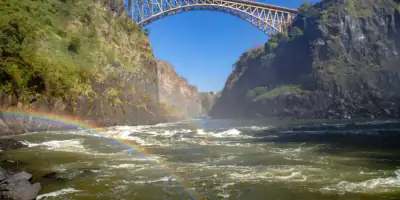
Walk out onto the Victoria Falls Bridge, built in 1905 over the Zambezi gorge, for the view of the falls and the river below; you need to clear Zimbabwean border formalities to reach the middle. In the afternoon, take a sunset cruise on the upper Zambezi to see hippos, crocodiles and elephants on the islands. If you have time, visit the Zambezi National Park upstream on a short game drive.
Signal On the bridge and the river your phone can connect to a Zambian network, which a Zimbabwe-only plan does not cover; watch the network name. Econet 4G is available in town.
Day 3 Hwange National Park
Victoria Falls to Hwange Main Camp is about 260 km, roughly 3 hours by road. Fill up with fuel in Victoria Falls and drive only in daylight.
Drive south-east to Hwange, Zimbabwe's largest national park, known for its very large elephant population. Check in at a camp or lodge near Main Camp, then go on an afternoon game drive to the waterholes, where pumped water draws elephants, buffalo, giraffe and antelope in the dry season. Stay at a viewing hide such as Nyamandhlovu Pan for the evening, if your camp allows.
Signal Econet 4G along the main A8 road and in Hwange town, but coverage is patchy at Main Camp and absent in most of the park. Lodges often have wifi when the power is on.
Day 4 Hwange National Park
Head out at dawn on a guided game drive, looking for lions, wild dogs and the sable and roan antelope found in the Kalahari woodland. Return for a midday break, then go out again in the late afternoon to the pans and waterholes, where elephants come to drink in herds. Some camps also offer guided walks with an armed ranger.
Signal Little or no signal on game drives. Treat this as an offline day and tell your contacts at home in advance.
Day 5 Bulawayo
Hwange to Bulawayo is about 335 km, roughly 4 hours by road. Watch for roadblocks and carry copies of your passport and visa.
Drive to Bulawayo, Zimbabwe's second city, with its wide colonial-era streets laid out for ox wagons to turn. Visit the Natural History Museum, one of the largest in Africa, with a huge collection of mammals and a recreated mine, and the National Railway Museum for its old steam locomotives. In the late afternoon, browse the gallery and craft shops at the National Gallery in Bulawayo.
Signal Econet 4G returns as you approach Bulawayo and is good in the city. Power cuts can affect masts, so charge your phone whenever you have power.
Day 6 Bulawayo
Matobo National Park is about 35 km south of Bulawayo, around 45 minutes by road.
Spend the day in Matobo National Park, part of the UNESCO-listed Matobo Hills, among granite domes and balancing boulders. Climb to World's View, Malindidzimu, where Cecil Rhodes is buried, and look out over the hills. Visit Nswatugi Cave to see San rock paintings of giraffe and antelope, and join a guided rhino-tracking walk in the park's game area if available.
Signal Econet coverage is patchy in the park; World's View usually has a weak signal, but the cave and walking areas often do not.
Day 7 Bulawayo
Khami is about 22 km west of Bulawayo, roughly 30 minutes by road; Bulawayo airport is about 25 km north of the city.
Visit the Khami Ruins, a UNESCO site west of Bulawayo, where the stone platforms and walls of the Torwa state's capital date from the 15th century, after Great Zimbabwe. Walk the terraces of the hill complex and the small site museum. Return to Bulawayo for your flight onward, or continue overland if you are heading on to Great Zimbabwe.
Signal Weak Econet signal at Khami. Download your boarding pass in town before you go.
Each block below says what was checked and when. Anything we cannot date, we do not claim.
| Data | Price | Per day |
|---|---|---|
| Unlimited | $21.99 | $7.33/day |
| Data | Price | Per day |
|---|---|---|
| Unlimited | $34.99 | $7.00/day |
| Data | Price | Per day |
|---|---|---|
| Unlimited | $65.99 | $6.60/day |
| Data | Price | Per day |
|---|---|---|
| Unlimited | $97.99 | $6.53/day |
| Data | Price | Per day |
|---|---|---|
| 3 GBBest value | $10.99 | $0.37/day |
| 5 GB | $16.00 | $0.53/day |
| 10 GB | $28.99 | $0.97/day |
| 20 GB | $58.99 | $1.97/day |
| Unlimited | $179.99 | $6.00/day |
| Data | Price | Per day |
|---|---|---|
| Unlimited | $359.99 | $6.00/day |
| Data | Price | Per day |
|---|---|---|
| Unlimited | $534.99 | $5.94/day |
| Data | Price | Per day |
|---|---|---|
| Unlimited | $1,069.99 | $5.94/day |
Going to more than one country?
Destinations