











eSIM for Morocco 
Viasimo's Morocco eSIM starts at $1.29 for 100 MB over 7 days, running on Orange Morocco with 5G where available. Plans last 1 to 180 days, arrive by email in minutes and install from your phone's settings, with no app.
Works everywhere in Morocco
- Agadir
- Beni Mellal-Khenifra
- Casablanca
- Casablanca-Settat
- Dakhla-Oued Ed-Dahab
- Drâa-Tafilalet
- Fes-Meknes
Select your planIn stock
Duration
Quantity
1
Unlimited data · 3 Days$12.99







Unlimited data · 3 Days ×1
$12.99
Does my phone take an eSIM? Check now
Dial *#06# on your phone. If you see an EID number, your phone takes an eSIM. Most phones sold since 2019 do.
Not sure it works on your phone? Check compatibilityWhich networks does the Morocco eSIM use?
Host networks: Orange Morocco
Your eSIM picks one automatically; you do not choose or switch between them.
- Data
- 100 MB – 50 GB or unlimited
- Validity
- 1–180 days
- Speed
- 4G LTE / 5G
- Hotspot / tethering
- Supported on most devices
- Activation
- Automatic on arrival
- Speed management
- Roughly 2-3 GB per day at full speed, sometimes less depending on the local carrier, then reduced
- Top-ups
- Add more data from your account, before the plan expires
- Text messages (SMS)
- Data only: use an app for verification codes
- Unused validity
- 180 days before it must be installed
How much data do you need?
The allowances below are our sizing recommendations, not measurements. The plan beside each one is the cheapest option on this page that covers it.
| You are | Plan for | Cheapest plan that covers it |
|---|---|---|
| LightMaps, messaging and the occasional lookup | About 1 GB a week | $2.591 GB, 7 days |
| TypicalMaps, social, photos and some browsing | About 3 to 7 GB a week | $9.005 GB, 30 days |
| HeavyVideo streaming, video calls and uploads | 10 GB a week or more | $16.0010 GB, 30 days |
| Working or sharingTethering a laptop, calls and cloud sync | 20 GB a week or more | $26.0020 GB, 30 days |
eSIM, local SIM or roaming?
Charged per day
Your carrier roaming
Queue and plastic
A SIM at the airport
$1.29
Viasimo, one bundle
Only the Viasimo figure is a price: it comes from today’s live catalog. The other two rows are directional, not quoted rates.
About this eSIM
Unlimited runs at full speed up to a fair-use limit, then continues slower.
Before you travel to Morocco
Do I have to register a SIM here?
Moroccan SIMs, prepaid included, must be registered to the buyer's official identity document; the regulator ANRT has banned anonymous SIMs since 2014. A travel eSIM avoids the paperwork.
Local SIM-registration rules apply to buying a SIM in the country. A travel eSIM is a foreign profile roaming onto the local network, so you are not registering anything locally and there is no counter to queue at.
What actually catches people out
Coverage is uneven between the cities and the countryside, so download offline maps before heading into the Atlas or the desert.
Checked 23 September 2026 against privacyinternational.org , lavieeco.com , freedomhouse.org . Rules change — verify anything that affects your trip.
Important to know
- This is a data-only eSIM. It carries no calls or SMS on its own number.
- Your existing number stays on your primary SIM, so calls and verification texts keep working.
- Your phone must support eSIM, and some carrier-locked phones cannot install one.
- Signal varies with location, terrain, congestion and your handset. Dense urban areas are consistently better served than remote ones.
- 5G only works where the host network has deployed it and your phone supports it. Everywhere else it falls back to 4G LTE.
- The eSIM selects a host network automatically. You cannot pick or switch between them.
- Unlimited plans run at full speed up to a fair-use limit, then continue at a reduced speed. Read the fair usage policy
Frequently asked questions
Does an eSIM work in Morocco?
Yes. Your Morocco eSIM connects automatically the moment you arrive, with no roaming fees and nothing to set up at the airport. The host networks it can use are Orange Morocco. Coverage runs on 4G LTE and 5G where the network has rolled it out, and falls back to 4G elsewhere.
Do I get 5G in Morocco?
Yes, where it has been deployed. 5G runs on Orange Morocco in Morocco, and your eSIM uses it automatically on a 5G-capable phone, dropping back to 4G LTE outside covered areas. No country is covered everywhere, so 5G availability varies by location.
Is there 5G in Morocco?
Yes. Orange Maroc, inwi and Maroc Telecom launched commercial 5G on 7 November 2025, according to the regulator ANRT, which said coverage reached about 38 percent of the population by the end of 2025. It is concentrated in the big cities such as Casablanca, Rabat, Marrakech, Tangier and Agadir. Elsewhere you'll be on 4G.
Can I bring a drone to Morocco?
Not without prior permission from the Moroccan government. The US State Department says drones are prohibited and that customs will confiscate them, so most visitors should leave theirs at home. Satellite phones are also strictly regulated and need authorisation to import or use, which is worth knowing before a desert or Atlas trek.
Can I take Moroccan dirhams home?
No. The dirham is a closed currency and taking it out of Morocco is prohibited. Change leftover dirhams back at a bank or airport exchange desk before you leave, and keep the receipts from when you changed money on arrival, because you'll need them to convert dirhams back into foreign currency.
Does Uber or Careem work in Morocco?
Ride-hailing apps such as Careem and inDrive operate in larger Moroccan cities, but their legal status is unclear while the government drafts new rules. The US State Department reports harassment of rideshare drivers and passengers by taxi drivers, especially near hotels and airports. Petit taxis are the standard option, and you should ask for the meter.
How much data do I need for 7 days in Morocco?
For 7 days in Morocco, Viasimo sells 100 MB for $1.29, 500 MB for $2.00, 1 GB for $2.59, and unlimited data for $27.99. Our sizing recommendation, not a measurement: maps, messaging and the occasional lookup, about 1 GB a week; maps, social, photos and some browsing, about 3 to 7 GB a week. The data calculator on this site works it out from how you actually use your phone.
Installing, keeping your number, topping up and hotspot work the same everywhere: see how it works →
Morocco: what to know before you land
Morocco's three operators switched on commercial 5G on 7 November 2025, and by the end of that year it reached about 38 percent of the population. Your eSIM runs on Orange Morocco, which market reports put slightly ahead of inwi and Maroc Telecom on subscriptions. Leave the drone and the satellite phone at home, and plan around a currency you can't take out of the country.
- Emergency
-
- 190 police; 19 from landlines
- 150 ambulance; 15 from landlines
- 177 Gendarmerie
- Plugs
- CE 230V
- Currency
- Moroccan dirham (MAD)
Main airports
- CMN Mohammed V International Airport (Casablanca)
- RAK Marrakesh Menara Airport
- AGA Agadir–Al Massira Airport
Apps worth having WhatsAppCareeminDriveONCF TraficGoogle Maps
Morocco's November 2025 5G launch with Orange
Morocco awarded 5G licences in 2025, and according to the regulator ANRT, Orange Maroc, inwi and Maroc Telecom all began commercial 5G on 7 November 2025, in time for the Africa Cup of Nations hosted in Moroccan cities that winter. By the end of 2025, ANRT put 5G population coverage at around 38 percent.
That figure tells you where 5G is: the big cities that hosted matches and fan zones, such as Casablanca, Rabat, Marrakech, Tangier, Fez and Agadir. In small towns, the Atlas, the gorges and the desert you'll be on 4G or slower.
Orange is a strong network to be on. Industry reports in 2025 had it slightly ahead of inwi and Maroc Telecom on mobile subscriptions, in a market of more than 58 million lines, far more than the population, because many Moroccans carry two SIMs.
Your eSIM uses Orange only. If a riad owner in the mountains says Maroc Telecom works better in their village, believe them and use the riad's wifi for anything heavy.
Drones, satellite phones and what customs will confiscate
Two gadgets that people often pack for a Sahara or Atlas trip can cause real trouble at Moroccan customs.
- Drones are prohibited without prior government authorisation, and the US State Department says the authorities will confiscate them. That includes drones in your hold luggage.
- Satellite phones are strictly regulated and also need prior authorisation to bring in or use. If you're planning a trek in Erg Chebbi or the High Atlas, rely on your guide's arrangements and your phone's mobile signal near villages instead.
Photography also has limits. Don't photograph royal palaces, embassies, government buildings, police or military sites. If you're unsure whether a building counts, ask before you raise your phone.
For emergencies, the State Department lists 190 for police (19 from a landline), 150 for an ambulance (15 from a landline) and 177 for the Gendarmerie Royale, which polices rural areas and main roads. 112 also works from mobiles. Save them as contacts before your first road trip.
Petit taxis, ride-hailing and the closed dirham
In the cities you'll use petit taxis, which are colour-coded by city: red in Casablanca, blue in Rabat and tan in Marrakech. Ask the driver to switch on the meter, and expect them sometimes to pick up other passengers on the way.
Ride-hailing apps such as Careem and inDrive work in larger cities, but they sit in a legal grey area while Morocco drafts legislation to regulate them. The State Department reports that rideshare drivers and passengers have been harassed by taxi drivers, particularly near hotels, airports and conference venues. Meeting your driver a short walk away from a taxi rank helps.
Money needs some planning, because the dirham (MAD) is a closed currency:
- You can't take dirhams out of Morocco. Change what's left at a bank or the airport before you fly home.
- Keep your exchange receipts, as you need them to convert dirhams back.
- Declare foreign currency above 15,000 dirhams on arrival.
- Larger hotels and shops take cards, sometimes with a fee. Souks, small cafés and taxis generally want cash. ATMs accept foreign cards.
Researched October 2026 · 4 sources
- en.wikipedia.org Telecommunications in Morocco (Wikipedia, citing ANRT)
- travel.state.gov Morocco International Travel Information (US State Department)
- worldstandards.eu Plug, socket and voltage by country (World Standards)
- en.wikipedia.org List of emergency telephone numbers (Wikipedia)
Seven days in Morocco: Marrakech, the High Atlas, the Dades Gorge, Erg Chebbi and Fez
The classic south-to-north crossing by car or private driver: two days in Marrakech's medina, over the High Atlas to Aït-Ben-Haddou, through the Dades and Todra gorges to a night in the Erg Chebbi dunes, then north through the Middle Atlas to Fez.
When to go March to May and October to November are best, with warm days and cold desert nights; summer is very hot in Marrakech and the Sahara, and winter can bring snow that closes the Tizi n'Tichka pass for a few hours or days.
-
Day 1 Marrakech
Marrakech: Jemaa el-Fna and the souks
Marrakech Menara airport (RAK) is about 15 minutes from the medina by petit taxi; agree a fare or insist on the meter.
Start at the Koutoubia Mosque, whose minaret you can admire from the gardens, then walk into Jemaa el-Fna, the great square at the heart of the UNESCO-listed medina. Spend the afternoon in the souks to the north, from the dyers' quarter to the leatherworkers, and visit the Ben Youssef Madrasa's carved cedar and tilework. Return to Jemaa el-Fna at dusk when the food stalls set up.
Signal Orange Morocco's 5G reaches parts of Marrakech; in the narrow, covered souk lanes signal often drops to weak 4G, so load your offline map first.
-
Day 2 Marrakech
Marrakech's palaces and gardens
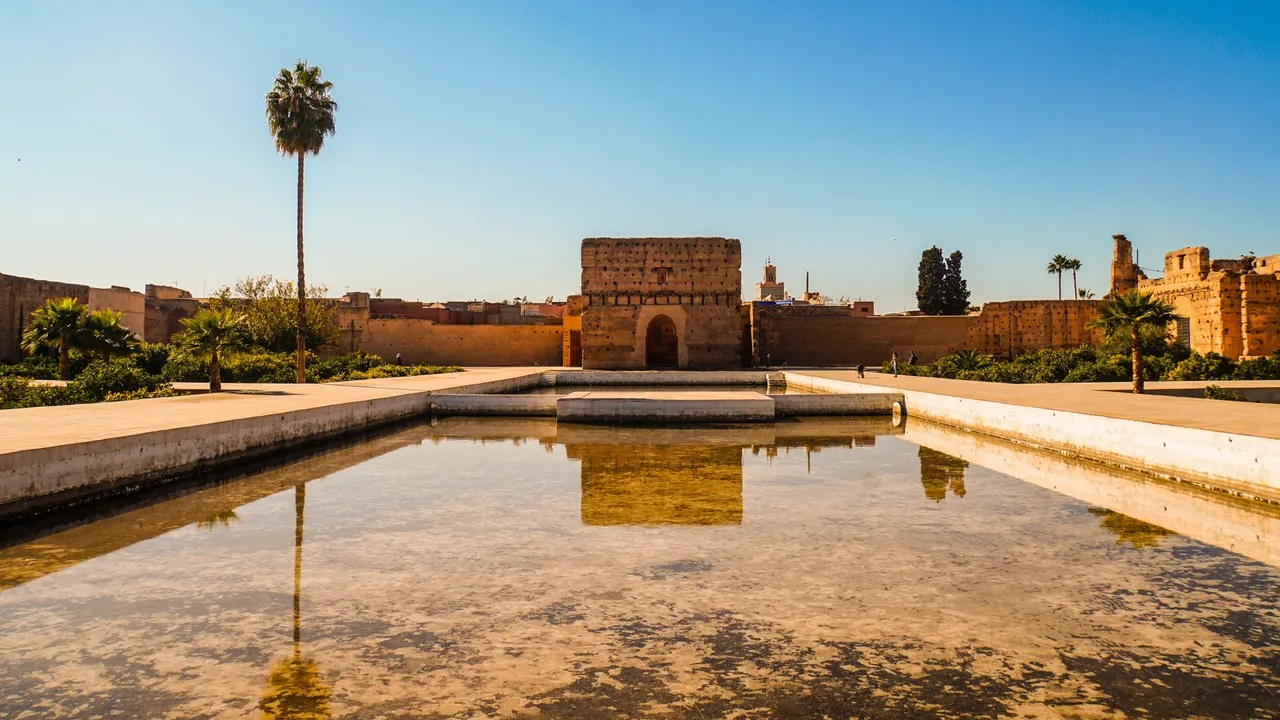
In the kasbah district, visit the Saadian Tombs and the ruined El Badi Palace, then the Bahia Palace's courtyards and painted ceilings. After lunch, take a taxi to the Jardin Majorelle, the cobalt-blue garden restored by Yves Saint Laurent, and the museum dedicated to him next door. End with a hammam or a rooftop view of the Atlas at sunset.
Signal Good 4G and some 5G across the new town, Gueliz and the kasbah district; thick palace walls weaken coverage indoors.
-
Day 3 Aït-Ben-Haddou
Over the Tizi n'Tichka to Aït-Ben-Haddou
About 4 hours by road from Marrakech, with mountain hairpins.
Drive south into the High Atlas on the N9, climbing through Berber villages to the Tizi n'Tichka pass at about 2,260 metres. Detour to the kasbah of Telouet if time allows. Descend to Aït-Ben-Haddou, the UNESCO-listed fortified village of earthen houses on a hill above the Ounila river, and climb to the granary at the top for sunset.
Signal 4G on most of the N9, with dead spots on the switchbacks either side of the pass; Aït-Ben-Haddou has 4G in the new village across the river.
-
Day 4 Dades Gorge
Ouarzazate and the Dades Gorge
About 3 hours by road from Aït-Ben-Haddou to Boumalne Dades and into the gorge.
Pass through Ouarzazate and visit the Taourirt Kasbah. Continue east along the Road of a Thousand Kasbahs through the Skoura palm grove and the rose-growing valley around Kelaat M'Gouna. Turn up into the Dades Gorge to see the rounded red rock formations and drive the famous hairpin bends above the river. Overnight in a guesthouse in the gorge.
Signal 4G in Ouarzazate and the towns on the N10; deep in the Dades Gorge coverage is patchy and some guesthouses rely on wifi.
-
Day 5 Merzouga (Erg Chebbi)
Todra Gorge and into the Erg Chebbi dunes
About 4 hours by road from the Dades Gorge to Merzouga.
Stop at the Todra Gorge near Tinghir and walk between its sheer walls, which rise around 300 metres above the stream. Drive on via Erfoud and Rissani to Merzouga at the edge of Erg Chebbi. In the late afternoon, ride or walk with camels into the dunes to a desert camp, and climb a dune for sunset. Stay in the camp overnight.
Signal 4G in Tinghir and Merzouga village; out in the dunes signal is weak to nil, though some camps near the edge pick up a bar. The Algerian border to the east is closed.
-
Day 6 Fez
North through the Ziz valley and the Middle Atlas to Fez
About 8 to 9 hours by road from Merzouga to Fez; a long day, so break it with stops.
Watch sunrise from the dunes, then start the long drive north. Follow the Ziz valley's palm groves and gorges past Errachidia, cross the Middle Atlas via Midelt, and stop in the cedar forest near Azrou to look for Barbary macaques. Pass through Ifrane, the alpine-style resort town, and arrive in Fez in the evening.
Signal Long stretches of the N13 between Errachidia and Midelt have weak or no signal; 4G returns around Azrou and Ifrane, and 5G may be available in Fez.
-
Day 7 Fez
Fez el-Bali: the medina
Fez–Saïss airport (FEZ) is about 20 minutes from the medina; trains also run to Rabat, Casablanca and Marrakech.
Spend the day in Fez el-Bali, the UNESCO-listed medieval medina, with a licensed guide to navigate its lanes. See the Bou Inania Madrasa, the outside of the Al-Qarawiyyin mosque and university, the Nejjarine fountain and the Chouara tannery from a leather shop balcony. Finish at the Marinid tombs on the hill for a view over the old city.
Signal Signal is weak in the deepest, narrowest lanes of the medina, so a downloaded offline map is essential; it improves on the hilltop and in the new town.
Staying connected on this route
- Download offline maps of the Marrakech and Fez medinas and of the N9, N10 and N13 before you set off.
- Your eSIM uses Orange only; in the mountains and desert, if your host says Maroc Telecom is stronger, use their wifi.
- Leave drones and satellite phones at home: both need prior authorisation and can be confiscated at customs.
- Tell family that the desert camp night may be offline.
Itinerary sources · 5
- whc.unesco.org Morocco World Heritage properties (UNESCO)
- en.wikivoyage.org Merzouga (Wikivoyage)
- gov.uk Morocco regional risks (GOV.UK)
- travel.state.gov Morocco International Travel Information (US State Department)
- en.wikipedia.org Telecommunications in Morocco (Wikipedia, citing ANRT)
Information and verification
Each block below says what was checked and when. Anything we cannot date, we do not claim.
- Prices and plans
- Every price and allowance on this page is read from the live catalog, not typed in.
- Host networks
- The operator list comes from the network partner that carries this eSIM.
- Local rules
- SIM registration and device rules, checked against the sources below.Source: privacyinternational.org, lavieeco.com, freedomhouse.org
Transparent pricing
Morocco eSIM prices
| Data | Price | Per day |
|---|---|---|
| Unlimited | $12.99 | $4.33/day |
| Data | Price | Per day |
|---|---|---|
| Unlimited | $20.99 | $4.20/day |
| Data | Price | Per day |
|---|---|---|
| 100 MBBest value | $1.29 | $0.18/day |
| 500 MB | $2.00 | $0.29/day |
| 1 GB | $2.59 | $0.37/day |
| Unlimited | $27.99 | $4.00/day |
| Data | Price | Per day |
|---|---|---|
| Unlimited | $37.99 | $3.80/day |
| Data | Price | Per day |
|---|---|---|
| Unlimited | $204.99 | $3.42/day |
| Data | Price | Per day |
|---|---|---|
| Unlimited | $309.99 | $3.44/day |
| Data | Price | Per day |
|---|---|---|
| Unlimited | $609.99 | $3.39/day |
Going to more than one country?
Regional plans that also cover Morocco
Destinations
Popular eSIM destinations
Travel guides

