










Jul 31, 2026 | 7 minute read

Viasimo's Egypt eSIM starts at $1.29 for 100 MB over 7 days, running on Orange with 5G where available. Plans last 1 to 180 days, arrive by email in minutes and install from your phone's settings, with no app.
Duration







Unlimited data · 3 Days ×1
$18.99
Dial *#06# on your phone. If you see an EID number, your phone takes an eSIM. Most phones sold since 2019 do.
Not sure it works on your phone? Check compatibilityHost networks: Orange
Your eSIM picks one automatically; you do not choose or switch between them.
The allowances below are our sizing recommendations, not measurements. The plan beside each one is the cheapest option on this page that covers it.
| You are | Plan for | Cheapest plan that covers it |
|---|---|---|
| LightMaps, messaging and the occasional lookup | About 1 GB a week | $2.791 GB, 7 days |
| TypicalMaps, social, photos and some browsing | About 3 to 7 GB a week | $10.995 GB, 30 days |
| HeavyVideo streaming, video calls and uploads | 10 GB a week or more | $21.9910 GB, 30 days |
| Working or sharingTethering a laptop, calls and cloud sync | 20 GB a week or more | $35.9920 GB, 30 days |
Charged per day
Your carrier roaming
Queue and plastic
A SIM at the airport
$1.29
Viasimo, one bundle
Only the Viasimo figure is a price: it comes from today’s live catalog. The other two rows are directional, not quoted rates.
Yes. Your Egypt eSIM connects automatically the moment you arrive, with no roaming fees and nothing to set up at the airport. The host networks it can use are Orange. Coverage runs on 4G LTE and 5G where the network has rolled it out, and falls back to 4G elsewhere.
Yes, where it has been deployed. 5G runs on Orange in Egypt, and your eSIM uses it automatically on a 5G-capable phone, dropping back to 4G LTE outside covered areas. No country is covered everywhere, so 5G availability varies by location.
Under the rules reintroduced on 21 January 2026, Ecofin Agency reports that tourists can keep using foreign SIM cards without paying duty, and that a local tourist SIM carries a 90-day exemption for each stay. Where duty is owed, it is paid through the NTRA's Telephony app, and unpaid phones are disconnected after 90 days. Check official guidance if you are staying long-term.
Yes, since June 2025. Vodafone Egypt launched on about 2,000 sites, including Cairo and parts of Upper Egypt, and Orange Egypt began in high-traffic areas. e& and Telecom Egypt hold 5G licences and were due to follow. Your eSIM can use Orange, Vodafone or Etisalat (e&), so you may see 5G in covered city areas and 4G elsewhere.
Not without prior permission from Egypt's Ministry of Defence, which is needed to import a drone at all. The UK Foreign Office warns that unauthorised use or import can mean up to seven years in prison or a fine of 5,000 to 50,000 Egyptian pounds. Flying near sensitive sites is illegal, so leave the drone at home unless you have a written permit.
Be very careful. It is illegal to photograph military property or anything near it, and the UK Foreign Office specifically includes the Suez Canal. Also avoid photographing embassies, government buildings and officials without consent. Ask permission before photographing Egyptian adults, and don't photograph children. Think twice before posting images online that could be seen as damaging to Egypt.
Dial 126 for the tourist police. For other emergencies, the numbers are 122 for police, 123 for an ambulance and 180 for fire. The eSIM is data-only, so place these calls from your home SIM while roaming or from a hotel landline, and save the numbers in your contacts before you arrive.
For 7 days in Egypt, Viasimo sells 100 MB for $1.29, 500 MB for $2.29, 1 GB for $2.79, and unlimited data for $38.99. Our sizing recommendation, not a measurement: maps, messaging and the occasional lookup, about 1 GB a week; maps, social, photos and some browsing, about 3 to 7 GB a week. The data calculator on this site works it out from how you actually use your phone.
Installing, keeping your number, topping up and hotspot work the same everywhere: see how it works →
Egypt switched on commercial 5G in June 2025, starting with Orange and Vodafone, and your eSIM can use Etisalat (now e&), Orange or Vodafone. Two recent changes affect visitors. Egypt reinstated customs duty on phones brought in from abroad in January 2026, and posting or flying drones near sensitive sites carries serious penalties.
Main airports
From noon on 21 January 2026, Egypt's customs authority and the telecoms regulator (NTRA) brought back duty on mobile phones that travellers bring in from abroad, and scrapped the on-arrival phone declaration. According to Ecofin Agency's report on the change, tourists can keep using foreign SIM cards without paying duty. A visitor who wants a local line can buy a "tourist SIM" from an Egyptian operator using their passport, and that carries a 90-day exemption for each stay.
Where duty is owed, the owner has 90 days to pay it by entering the handset's IMEI in the NTRA's Telephony app. Phones still unpaid after that are cut off from every Egyptian network. Egyptians living abroad have a separate 90-day exemption for each visit.
A travel eSIM is a foreign SIM, so it lets you avoid the local-SIM paperwork entirely. Rules here have changed several times since 2024, though. If you plan to stay for months, bring a second handset to sell, or later insert a local SIM, check the current NTRA and customs guidance before you travel.
Egypt awarded 5G spectrum to all four operators in October 2024, and the first commercial networks went live in June 2025. Vodafone Egypt launched with about 2,000 sites across several governorates, including Cairo and parts of Upper Egypt. Orange Egypt started in high-traffic areas. e& (formerly Etisalat Misr) and the state-owned Telecom Egypt (WE) both hold 5G rights and were expected to follow in later phases.
Your eSIM can use Etisalat, Orange or Vodafone. In 5G areas, a compatible phone may connect to 5G on Orange or Vodafone; on e&, expect 4G unless its own 5G has reached the area you are in. GSMA research credits the arrival of 5G with lifting Egypt's overall mobile performance, but the coverage is still concentrated in the cities. Treat 5G as a bonus around Cairo and the main Nile cities rather than something to count on across the country.
If your phone shows a network name such as "e& EG" instead of Etisalat, that is the same operator under its newer brand.
Egypt is strict about what you film and share, and a phone makes it easy to cross a line without meaning to. The UK Foreign Office says drones cannot be imported or flown without prior permission from the Ministry of Defence. Unauthorised use or import can lead to up to seven years in prison or a fine of 5,000 to 50,000 Egyptian pounds. Leave the drone at home unless you have that permit in writing.
It is also illegal to photograph military property or anything near it, and the Suez Canal counts. Get permission before photographing embassies, government buildings, infrastructure or religious buildings, ask Egyptian adults before photographing them, and avoid photographing children. Taking or sharing images considered damaging to Egypt's image is an offence.
What you post matters too. The Foreign Office warns that negative comments about the government, including on social media, can lead to detention. Some travellers have been arrested over sexual content or discussions online. LGBT+ people have been prosecuted under "debauchery" laws. Think before you post while you are in the country.
In Cairo, Uber lets you book an UberXL for groups of up to six, or request a regular Cairo taxi through the app and pay for it there. You can also schedule a ride up to 30 days ahead, which helps if you land at Cairo International (CAI) in the middle of the night. Either way, you need mobile data both to book and to track the car.
The Foreign Office advises women travelling alone to take particular care in taxis, especially at night. If you can't avoid a solo ride, share the driver's details, the trip and your live location with a friend. Ride apps and messaging make that easy. It also advises against driving outside the main cities and resorts after dark.
Keep the emergency numbers in your phone:
The eSIM is data-only, so make these calls from your home SIM, which can still reach the emergency services while roaming, or from your hotel phone.
A classic first visit that pairs the pyramids and museums of Cairo with the temples of the Nile Valley, flying south to Aswan and travelling by road to Luxor. It suits travellers happy with early starts to beat the heat and the crowds.
When to go October to April is the comfortable season, with mild days in Cairo and warm, dry weather in Luxor and Aswan; from June to September Upper Egypt often passes 40°C, so plan outdoor sites for early morning.
Day 1 Cairo
Cairo International (CAI) is about 45–60 minutes from central Cairo by road, depending on traffic; Uber works from the airport.
Start at the Citadel of Saladin and the Mosque of Muhammad Ali, with views across the city. Walk or take a taxi down to the Sultan Hassan and Al-Rifai mosques below it, then on to Al-Azhar Mosque. Spend the late afternoon walking along Al-Muizz Street, lined with medieval mosques, madrasas and the Qalawun complex, and end in the Khan el-Khalili bazaar as the lamps come on.
Signal Central Cairo has strong 4G and some 5G on Orange and Vodafone, though data slows in the narrow lanes of Khan el-Khalili when it is crowded.
Day 2 Cairo
Giza is about 45 minutes to an hour from central Cairo by road.
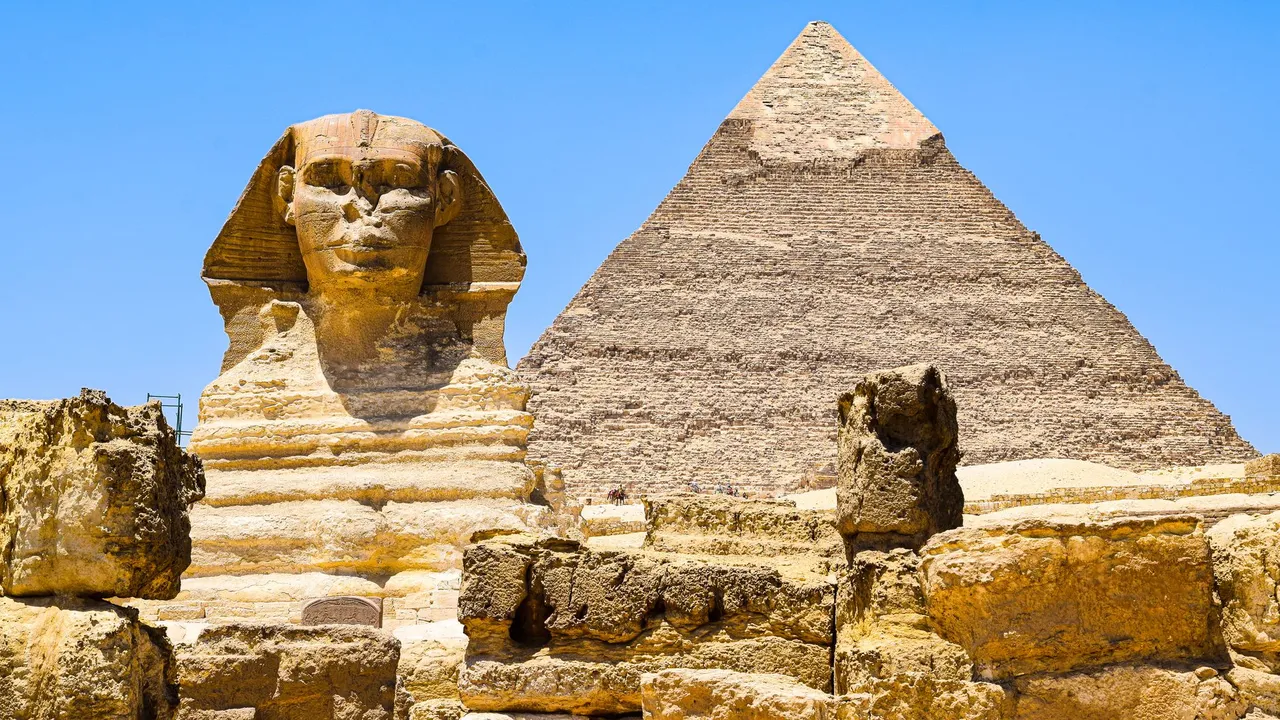
Arrive at the Giza plateau at opening time to see the Great Pyramid of Khufu, the pyramids of Khafre and Menkaure, and the Sphinx, ideally with a camel or horse ride around the panorama viewpoint arranged through an official guide. In the afternoon, visit the Grand Egyptian Museum next to the plateau, which holds the Tutankhamun collection and the colossal statue of Ramesses II in its entrance atrium, below the Grand Staircase of royal statues.
Signal Good 4G across the Giza plateau and at the museum; do not fly a drone or film military or security buildings around the site.
Day 3 Aswan
Saqqara is about 1 hour from central Cairo by road; the domestic flight from Cairo to Aswan takes about 1 hour 25 minutes.
Spend the morning south of Cairo at Saqqara, where the Step Pyramid of Djoser is the oldest large stone building in Egypt, and look into the painted tombs of the nobles nearby. Continue to Dahshur to see the Bent Pyramid and the Red Pyramid, which you can enter by a long, steep passage. Return towards the airport for an evening flight to Aswan.
Signal 4G works at Saqqara and Dahshur, but there is no signal inside the pyramid passages; Aswan town has good 4G.
Day 4 Aswan
About 3–3½ hours each way by road across the desert from Aswan; short flights also run from Aswan to Abu Simbel.
Leave very early for Abu Simbel, where Ramesses II's two rock-cut temples were moved block by block in the 1960s to save them from Lake Nasser. Spend a couple of hours in the Great Temple and the Temple of Nefertari, then return to Aswan. In the late afternoon, take a felucca sail around Elephantine Island and Kitchener's Island (the botanical garden) as the light drops.
Signal There are long stretches of the Abu Simbel desert road with weak or no signal, so download maps and entertainment before you leave; Abu Simbel town and the Nile at Aswan have 4G.
Day 5 Luxor
Aswan to Luxor is about 3½–4 hours by road without stops; allow a full day with the temples. A Nile cruise covers the same stretch over 3–4 nights.
Take a boat to Philae, the Temple of Isis on Agilkia Island, rescued from the rising Nile and reassembled in the 1970s. Then drive north, stopping at Kom Ombo, a temple shared by the crocodile god Sobek and the falcon god Horus, with its mummified crocodile museum. Continue to Edfu to see the Temple of Horus, one of the best-preserved temples in Egypt, before arriving in Luxor in the evening.
Signal 4G holds in Aswan, Kom Ombo, Edfu and Luxor, with short gaps on the road between towns; coverage on the boat to Philae is reliable.
Day 6 Luxor
The West Bank is about 20 minutes from the city by bridge or a few minutes by ferry.
Cross to the West Bank early. Visit the Valley of the Kings, where a standard ticket includes three tombs, and pay extra for Tutankhamun's tomb or Seti I's if you want. Continue to the Temple of Hatshepsut at Deir el-Bahari, built in terraces against the cliffs, then Medinet Habu, Ramesses III's mortuary temple with deep-cut reliefs. Stop at the Colossi of Memnon on the way back to the river.
Signal There is good 4G at the visitor centres and car parks, but none inside the tombs, and photography rules vary by site, so check before you take your phone out.
Day 7 Luxor
Domestic flights from Luxor to Cairo take about 1 hour; Luxor airport is about 20 minutes from the centre.
Spend the morning at Karnak, the largest temple complex in Egypt, walking through the Great Hypostyle Hall with its 134 columns, past the sacred lake and the obelisks. Visit the Luxor Museum in the afternoon, then walk along the Avenue of Sphinxes to Luxor Temple, best seen around sunset when it is lit up. Fly back to Cairo in the evening for your international departure.
Signal Luxor's East Bank has strong 4G and some 5G in central areas, so you can manage flight check-in and ride bookings from the temples.
Each block below says what was checked and when. Anything we cannot date, we do not claim.
| Data | Price | Per day |
|---|---|---|
| Unlimited | $18.99 | $6.33/day |
| Data | Price | Per day |
|---|---|---|
| Unlimited | $27.99 | $5.60/day |
| Data | Price | Per day |
|---|---|---|
| 100 MBBest value | $1.29 | $0.18/day |
| 500 MB | $2.29 | $0.33/day |
| 1 GB | $2.79 | $0.40/day |
| Unlimited | $38.99 | $5.57/day |
| Data | Price | Per day |
|---|---|---|
| Unlimited | $52.99 | $5.30/day |
| Data | Price | Per day |
|---|---|---|
| Unlimited | $284.99 | $4.75/day |
| Data | Price | Per day |
|---|---|---|
| Unlimited | $429.99 | $4.78/day |
| Data | Price | Per day |
|---|---|---|
| Unlimited | $854.99 | $4.75/day |
Going to more than one country?
Destinations
Travel guides
Jul 31, 2026 | 7 minute read
As featured on
