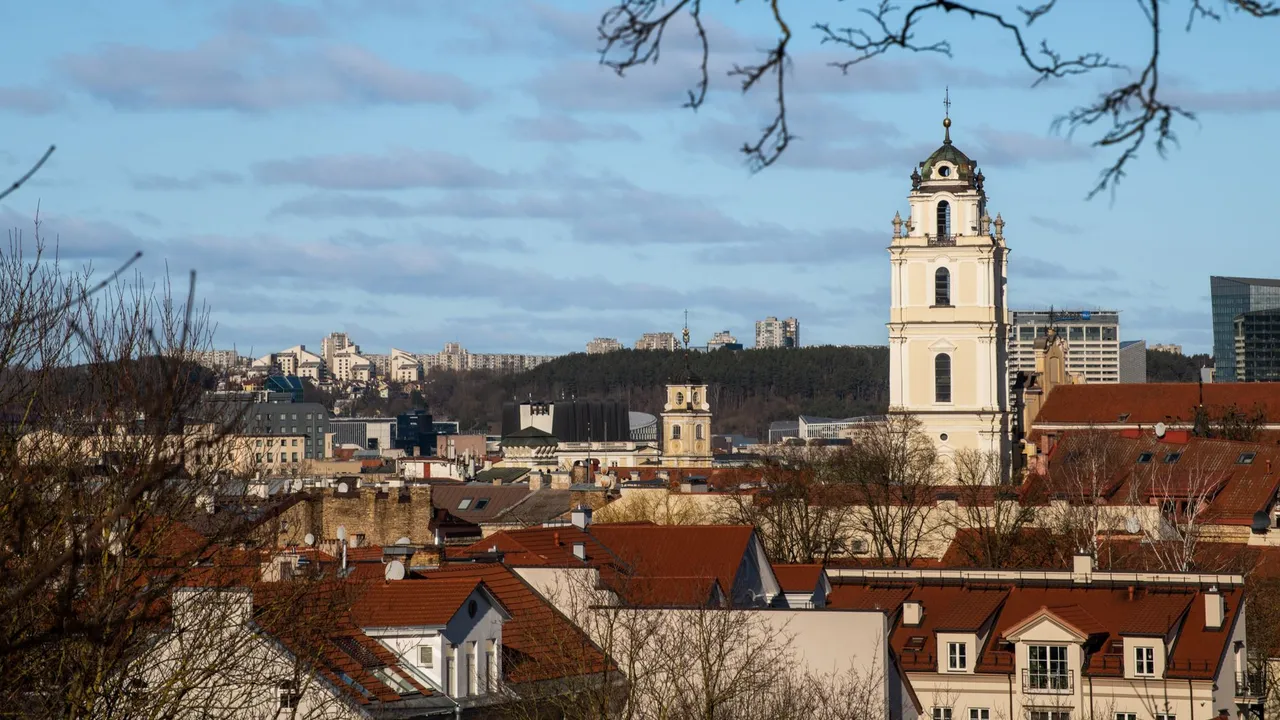
eSIM for Lithuania 
Viasimo's Lithuania eSIM starts at $1.29 for 500 MB over 1 day, running on Tele2 and Telia with 5G where available. Plans last 1 to 180 days, arrive by email in minutes and install from your phone's settings, with no app.
Works everywhere in Lithuania
- Alytus
- Kaunas
- Klaipėda County
- Marijampolė County
- Panevėžys
- Siauliai
- Tauragė County
Duration







Unlimited data · 3 Days ×1
$6.99
Does my phone take an eSIM? Check now
Dial *#06# on your phone. If you see an EID number, your phone takes an eSIM. Most phones sold since 2019 do.
Not sure it works on your phone? Check compatibilityWhich networks does the Lithuania eSIM use?
Host networks: Tele2 / Telia
Your eSIM picks one automatically; you do not choose or switch between them.
- Data
- 500 MB – 50 GB or unlimited
- Validity
- 1–180 days
- Speed
- 4G LTE / 5G
- Hotspot / tethering
- Supported on most devices
- Activation
- Starts when you first connect in your destination
- Speed management
- Roughly 2-3 GB per day at full speed, sometimes less depending on the local carrier, then reduced
- Top-ups
- Add more data from your account, before the plan expires
- Text messages (SMS)
- Data only: use an app for verification codes
- Unused validity
- 180 days before it must be installed
How much data do you need?
The allowances below are our sizing recommendations, not measurements. The plan beside each one is the cheapest option on this page that covers it.
| You are | Plan for | Cheapest plan that covers it |
|---|---|---|
| LightMaps, messaging and the occasional lookup | About 1 GB a week | $1.591 GB, 7 days |
| TypicalMaps, social, photos and some browsing | About 3 to 7 GB a week | $4.595 GB, 30 days |
| HeavyVideo streaming, video calls and uploads | 10 GB a week or more | $8.0010 GB, 30 days |
| Working or sharingTethering a laptop, calls and cloud sync | 20 GB a week or more | $13.99Unlimited, 7 days |
eSIM, local SIM or roaming?
Charged per day
Your carrier roaming
Queue and plastic
A SIM at the airport
$1.29
Viasimo, one bundle
Only the Viasimo figure is a price: it comes from today’s live catalog. The other two rows are directional, not quoted rates.
Important to know
- This is a data-only eSIM. It carries no calls or SMS on its own number.
- Your existing number stays on your primary SIM, so calls and verification texts keep working.
- Your phone must support eSIM, and some carrier-locked phones cannot install one.
- Signal varies with location, terrain, congestion and your handset. Dense urban areas are consistently better served than remote ones.
- 5G only works where the host network has deployed it and your phone supports it. Everywhere else it falls back to 4G LTE.
- The eSIM selects a host network automatically. You cannot pick or switch between them.
- Unlimited plans run at full speed up to a fair-use limit, then continue at a reduced speed. Read the fair usage policy
Frequently asked questions
Does an eSIM work in Lithuania?
Yes. Your Lithuania eSIM connects automatically the moment you arrive, with no roaming fees and nothing to set up at the airport. The host networks it can use are Tele2, Telia. Coverage runs on 4G LTE and 5G where the network has rolled it out, and falls back to 4G elsewhere.
Do I get 5G in Lithuania?
Yes, where it has been deployed. 5G runs on Tele2, Telia in Lithuania, and your eSIM uses it automatically on a 5G-capable phone, dropping back to 4G LTE outside covered areas. No country is covered everywhere, so 5G availability varies by location.
Which mobile networks does Lithuania have?
Three: Telia, Tele2 and Bitė. Your eSIM can use Telia or Tele2, with 5G where available. In Opensignal's September 2022 report, Telia won the Excellent Consistent Quality award and shared Core Consistent Quality with Bitė. EU data shows 5G reached about 90% of Lithuanian households in 2022, above the EU average.
Why was Vilnius Airport closed in 2025?
Several times in 2025, Vilnius Airport (VNO) suspended flights after helium balloons drifted in from Belarus. They were being used to smuggle cigarettes. Closures can happen at short notice, so keep your airline's app installed with alerts turned on. Mobile data lets you check rebooking or a diversion to Kaunas (KUN) straight away.
Can I cross from Lithuania into Belarus?
In late October 2025 Lithuania closed its Belarus border for at least a month, leaving only the Medininkai–Kamenny Log crossing open to private vehicles. Scheduled buses stopped running. UK nationals were exempt from the closure. Check the latest Lithuanian government or UK Foreign Office advice before travelling, and arrange separate connectivity, as this eSIM covers Lithuania only.
How do I get from Vilnius Airport to the city centre?
A direct train runs from Vilnius Airport station to Vilnius central station in about eight minutes, covering roughly 4 km. The airport is only about 6 km from the centre, so taxis and ride-hailing are short trips too. Switch your eSIM on after landing so you can check train times or book a car before you leave arrivals.
How much data do I need for 7 days in Lithuania?
For 7 days in Lithuania, Viasimo sells 1 GB for $1.59 and unlimited data for $13.99. Our sizing recommendation, not a measurement: maps, messaging and the occasional lookup, about 1 GB a week; maps, social, photos and some browsing, about 3 to 7 GB a week. The data calculator on this site works it out from how you actually use your phone.
Installing, keeping your number, topping up and hotspot work the same everywhere: see how it works →
Lithuania: what to know before you land
In Lithuania your eSIM uses Telia or Tele2, with 5G where it is available, and the country's 5G covered about 90% of households by 2022, ahead of the EU average. A few things are worth checking before you travel: balloon-related closures at Vilnius Airport in 2025, short-notice closures of the Belarus border, and new EU biometric checks on arrival.
- Emergency
- 112
- Plugs
- CF 230V
- Currency
- Euro (EUR)
Main airports
- VNO Vilnius Airport
- KUN Kaunas Airport
- PLQ Palanga Airport
Telia, Tele2 and Bitė: Lithuania's three networks
Lithuania has three mobile network operators: Telia, Tele2 and Bitė. Your eSIM can connect to Telia or Tele2. It does not use Bitė, so don't be surprised if friends on Bitė report a slightly different picture.
The country moved to 5G quickly. European Commission figures quoted for the regulator RRT show 5G covering 33% of households in 2021 and 90% in 2022, above the EU average of 81% that year. The share of the usable 5G radio spectrum actually assigned, though, was still below the EU average in 2023. In practice that means 5G signal is widespread, while the fastest speeds are concentrated in Vilnius, Kaunas and Klaipėda.
Opensignal's most recent Lithuania report, from September 2022, gave Telia the award for Excellent Consistent Quality, a measure of how often a connection is good enough for demanding apps such as video calls and gaming. Telia shared the Core Consistent Quality award with Bitė. Because your eSIM can choose between Telia and Tele2, it can switch to whichever has the stronger signal as you travel.
Vilnius Airport (VNO) closures and the 8-minute train
Vilnius Airport (VNO) is only about 6 km south of the city centre. A direct train runs from the airport station to Vilnius central station in about eight minutes. That is often quicker than a taxi at rush hour, and you can check the departure times on your phone as soon as you land. airBaltic, Ryanair and Wizz Air have bases here, and LOT, Lufthansa, SAS, Finnair and Turkish Airlines also fly in.
In 2025 the airport was closed several times, sometimes for hours, after helium balloons drifted across from Belarus. The balloons were being used to smuggle cigarettes into the EU. Closures like this happen at short notice, so keep your airline's app installed with notifications turned on. If a closure happens, you will want to check rebooking options and diversions to Kaunas (KUN) without hunting for wifi.
If you are coming from outside the EU, you will go through the EU Entry/Exit System (EES) on arrival. It records your fingerprints and a photo, and the digital record lasts three years. Border staff can also ask to see accommodation, insurance, an onward ticket and proof of funds, so keep those saved offline on your phone.
The Belarus border at Medininkai and the Russian half of the Curonian Spit
On 29 October 2025 Lithuania announced it was closing its border with Belarus until at least 30 November 2025. According to the UK Foreign Office, only the Medininkai–Kamenny Log crossing stayed open, for private vehicles, scheduled buses stopped running, and cars registered in Belarus were generally refused entry. UK nationals were exempt from the closure. The situation can change at short notice, so check the Lithuanian government's current position before planning any overland trip east. In any case, this eSIM covers Lithuania only, so you would need separate connectivity in Belarus.
In the west, the Curonian Spit is split between Lithuania and Russia. The southern half belongs to Kaliningrad, and if you walk far enough south from Nida you reach Russian territory. The Foreign Office points travellers to its Russia advice for that side.
The Foreign Office also notes that some drones heading for Russia have strayed into Lithuanian airspace. If an incident happens, official alerts and news will reach you through your phone. Keep notifications on and follow official guidance. The emergency number throughout Lithuania is 112. Call it from your home SIM, because the eSIM is data-only.
Researched October 2026 · 5 sources
- insights.opensignal.com Lithuania mobile network experience report (Opensignal)
- en.wikipedia.org Telecommunications in Lithuania (Wikipedia)
- en.wikipedia.org Vilnius Airport (Wikipedia)
- gov.uk Lithuania travel advice: entry requirements (GOV.UK)
- gov.uk Lithuania travel advice: safety and security (GOV.UK)
Seven days in Lithuania: Vilnius, Trakai, Kaunas, the Hill of Crosses and the Curonian Spit
A west-bound week from Vilnius's baroque old town to the dunes of the Curonian Spit, with Trakai's island castle, interwar Kaunas and the Hill of Crosses on the way. Trains and buses cover most of it; a car helps on the Spit.
When to go May to September is the season for the Curonian Spit, with long light evenings around midsummer and the warmest sea in July and August; Vilnius is good year-round, with Christmas markets in December, but winter days are short and cold.
-
Day 1 Vilnius
Vilnius Old Town
The airport train reaches Vilnius central station in about 8 minutes; the airport is about 6 km from the centre.
Start at Cathedral Square and the Palace of the Grand Dukes, then ride the funicular or walk up to Gediminas' Tower for the view over the red roofs of the UNESCO-listed Old Town. Walk down Pilies street to Vilnius University's courtyards and St Anne's Church, a Gothic brick facade beside the Bernardine monastery. End the day at the Gate of Dawn, the only surviving city gate, with its chapel holding an icon of the Virgin Mary.
Signal Vilnius has strong 5G and 4G on Telia and Tele2 across the Old Town; streaming and video calls work almost everywhere.
-
Day 2 Vilnius
Užupis and the Museum of Occupations
Cross the bridge into Užupis, the self-declared artists' 'republic', and read its humorous constitution on the wall of Paupio street. In the late morning, visit the Museum of Occupations and Freedom Fights in the former KGB headquarters, including the basement prison cells. In the afternoon, see the Church of St Peter and St Paul in Antakalnis, known for its white stucco interior, and finish at the Vilnius TV Tower or the riverside parks.
Signal Good 5G across the centre; the museum's basement cells have weaker signal, but it is a short visit.
-
Day 3 Vilnius
Day trip to Trakai
Trains from Vilnius to Trakai take about 30–40 minutes; buses are similar.
Take the train or bus to Trakai, once a capital of the Grand Duchy of Lithuania. Walk the wooden footbridges to the Trakai Island Castle on Lake Galvė, a red-brick fortress with a museum inside. Explore the Karaim street with its painted wooden houses with three windows facing the road, and try kibinai, the pastry brought by the Karaim community from Crimea. In summer, hire a pedal boat or kayak on the lake before returning to Vilnius.
Signal 4G and 5G are reliable in Trakai town and at the castle; coverage holds on the lake too.
-
Day 4 Kaunas
Kaunas: the old town and interwar architecture
Trains from Vilnius to Kaunas take about 1 hour 10 minutes to 1 hour 20 minutes.
Take the train to Kaunas, Lithuania's capital between the wars. Walk Laisvės alėja, the long pedestrian boulevard, to the Christ's Resurrection Church, whose roof terrace has views over the city. Kaunas's interwar modernist buildings are on the UNESCO list; see the Central Post Office and the Vytautas the Great War Museum. Visit the Devils' Museum, then wander the old town to Kaunas Castle and the Town Hall square.
Signal Kaunas has widespread 5G; the route between the two cities is well covered by 4G and 5G.
-
Day 5 Klaipėda
The Hill of Crosses and on to Klaipėda
About 2 hours by road from Kaunas to the Hill of Crosses, then about 2 hours from there to Klaipėda; by public transport, go via Šiauliai.
Spend the morning at the Ninth Fort memorial in Kaunas, a 19th-century fortress where tens of thousands of people, most of them Jews, were murdered during the Nazi occupation. Then travel north to the Hill of Crosses near Šiauliai, a mound covered with more than 100,000 crosses that the Soviet authorities bulldozed several times. Continue west to Klaipėda, Lithuania's port city, for the night.
Signal 4G is reliable on the main roads; the Hill of Crosses has a usable connection, and Klaipėda has 5G in the centre.
-
Day 6 Nida
The Curonian Spit: Juodkrantė and Nida
The ferry to Smiltynė takes about 5–10 minutes; Smiltynė to Nida is about 50 km, roughly 45 minutes to an hour by road.
Take the short ferry from Klaipėda to Smiltynė and drive or take a bus down the Curonian Spit, a narrow strip of dunes and pine forest between the lagoon and the Baltic, listed by UNESCO. Stop at the Hill of Witches in Juodkrantė, a forest trail with wooden carvings. In Nida, walk up the Parnidis dune for views over the sand towards the Russian border, then visit the Thomas Mann summer house and walk along the lagoon front.
Signal Coverage is generally fine in Juodkrantė and Nida, but near the dunes south of Nida your phone may pick up a Russian (Kaliningrad) network, which this plan does not cover; select Telia or Tele2 manually.
-
Day 7 Klaipėda
Klaipėda old town and the trip back
Palanga airport (PLQ) is about 30 minutes north of Klaipėda; trains from Klaipėda to Vilnius take about 4 hours.
Return to Klaipėda and walk around its old town, with half-timbered warehouses, Theatre Square and the Ännchen von Tharau statue, and the sailing ship Meridianas moored on the river Danė. If you fly out from Palanga airport, stop at Palanga's long pier and its Amber Museum in Tiškevičiai Palace on the way. Otherwise, take the train back to Vilnius.
Signal Klaipėda, Palanga and the Klaipėda–Vilnius railway have reliable 4G and 5G for most of the journey.
Staying connected on this route
- On the Curonian Spit, set your network selection to Telia or Tele2 manually so your phone does not roam onto Russian networks near the Kaliningrad border.
- Keep your airline's app notifications on, as Vilnius Airport has had short-notice closures.
- Do not walk south past the border markers beyond Nida; the southern half of the Spit is Russian territory.
- Save EES-related documents such as accommodation and return tickets offline before your flight.
Itinerary sources · 5
- whc.unesco.org UNESCO World Heritage: Vilnius Historic Centre
- whc.unesco.org UNESCO World Heritage: Curonian Spit
- whc.unesco.org UNESCO World Heritage: Modernist Kaunas
- gov.uk GOV.UK foreign travel advice: Lithuania safety and security
- en.wikipedia.org Wikipedia: Vilnius Airport
Information and verification
Each block below says what was checked and when. Anything we cannot date, we do not claim.
- Prices and plans
- Every price and allowance on this page is read from the live catalog, not typed in.
- Host networks
- The operator list comes from the network partner that carries this eSIM.
Lithuania eSIM prices
| Data | Price | Per day |
|---|---|---|
| Unlimited | $6.99 | $2.33/day |
| Data | Price | Per day |
|---|---|---|
| Unlimited | $10.99 | $2.20/day |
| Data | Price | Per day |
|---|---|---|
| Unlimited | $18.99 | $1.90/day |
| Data | Price | Per day |
|---|---|---|
| 3 GBBest value | $3.29 | $0.11/day |
| 5 GB | $4.59 | $0.15/day |
| 10 GB | $8.00 | $0.27/day |
| 20 GB | $17.00 | $0.57/day |
| Unlimited | $50.00 | $1.67/day |
| Data | Price | Per day |
|---|---|---|
| Unlimited | $97.99 | $1.63/day |
| Data | Price | Per day |
|---|---|---|
| Unlimited | $149.99 | $1.67/day |
Going to more than one country?
Regional plans that also cover Lithuania




Destinations