








eSIM for Greece 
Viasimo's Greece eSIM starts at $1.29 for 500 MB over 7 days, running on Nova and Vodafone with 5G where available. Plans last 1 to 180 days, arrive by email in minutes and install from your phone's settings, with no app.
Works everywhere in Greece
- Athens
- Attica
- Central Greece
- Central Macedonia
- Crete
- East Macedonia and Thrace
- Epirus
Select your planIn stock
Duration
Quantity
1
Unlimited data · 3 Days$6.99







Unlimited data · 3 Days ×1
$6.99
Does my phone take an eSIM? Check now
Dial *#06# on your phone. If you see an EID number, your phone takes an eSIM. Most phones sold since 2019 do.
Not sure it works on your phone? Check compatibilityWhich networks does the Greece eSIM use?
Host networks: Nova / Vodafone
Your eSIM picks one automatically; you do not choose or switch between them.
- Data
- 500 MB – 50 GB or unlimited
- Validity
- 1–180 days
- Speed
- 4G LTE / 5G
- Hotspot / tethering
- Supported on most devices
- Activation
- Starts when you first connect in your destination
- Speed management
- Roughly 2-3 GB per day at full speed, sometimes less depending on the local carrier, then reduced
- Top-ups
- Add more data from your account, before the plan expires
- Text messages (SMS)
- Data only: use an app for verification codes
- Unused validity
- 180 days before it must be installed
How much data do you need?
The allowances below are our sizing recommendations, not measurements. The plan beside each one is the cheapest option on this page that covers it.
| You are | Plan for | Cheapest plan that covers it |
|---|---|---|
| LightMaps, messaging and the occasional lookup | About 1 GB a week | $1.591 GB, 7 days |
| TypicalMaps, social, photos and some browsing | About 3 to 7 GB a week | $4.595 GB, 30 days |
| HeavyVideo streaming, video calls and uploads | 10 GB a week or more | $8.0010 GB, 30 days |
| Working or sharingTethering a laptop, calls and cloud sync | 20 GB a week or more | $13.99Unlimited, 7 days |
eSIM, local SIM or roaming?
Charged per day
Your carrier roaming
Queue and plastic
A SIM at the airport
$1.29
Viasimo, one bundle
Only the Viasimo figure is a price: it comes from today’s live catalog. The other two rows are directional, not quoted rates.
Important to know
- This is a data-only eSIM. It carries no calls or SMS on its own number.
- Your existing number stays on your primary SIM, so calls and verification texts keep working.
- Your phone must support eSIM, and some carrier-locked phones cannot install one.
- Signal varies with location, terrain, congestion and your handset. Dense urban areas are consistently better served than remote ones.
- 5G only works where the host network has deployed it and your phone supports it. Everywhere else it falls back to 4G LTE.
- The eSIM selects a host network automatically. You cannot pick or switch between them.
- Unlimited plans run at full speed up to a fair-use limit, then continue at a reduced speed. Read the fair usage policy
Frequently asked questions
Does an eSIM work in Greece?
Yes. Your Greece eSIM connects automatically the moment you arrive, with no roaming fees and nothing to set up at the airport. The host networks it can use are Nova, Vodafone. Coverage runs on 4G LTE and 5G where the network has rolled it out, and falls back to 4G elsewhere.
Do I get 5G in Greece?
Yes, where it has been deployed. 5G runs on Nova, Vodafone in Greece, and your eSIM uses it automatically on a 5G-capable phone, dropping back to 4G LTE outside covered areas. No country is covered everywhere, so 5G availability varies by location.
Is Wind the same as Nova in Greece?
Yes. Wind Hellas merged with Nova in January 2023 under United Group, and its mobile service now carries the Nova name. If your phone shows Nova in the status bar, you are on the former Wind network, which this eSIM uses alongside Vodafone. Cosmote is the third Greek network.
Which mobile network is fastest in Greece?
Opensignal's March 2026 report puts Cosmote ahead on download speed at 71.9 Mbps, against 51.6 Mbps on Vodafone and 45.6 Mbps on Nova. Vodafone, which this eSIM uses with Nova, won for reliability and time on network, and its users were connected to 5G 91% of the time, the highest figure in Greece.
Will I get wildfire alerts on my phone in Greece?
Greece's 112 Emergency Communication Service sends location-based alerts, including evacuation orders, to phones in the affected area. Make sure emergency alerts are switched on in your phone's notification settings, keep the phone with you and follow 112 Greece on X. Fire risk is highest from April to October.
Do I need a helmet to ride a quad bike in Greece?
Yes. Helmets are compulsory for drivers and passengers, and police can fine you and take your licence if you ride without one. Not wearing a helmet may also invalidate your insurance. Provisional licences are not accepted, and many travel policies exclude quad biking, so check your cover before you hire.
What is the emergency number in Greece?
Dial 112 for ambulance, fire and police anywhere in Greece. Dialling 999 from a UK mobile also connects you to the Greek emergency services. You need a voice line for this, and this eSIM is data only, so keep your home SIM switched on while you travel.
How much data do I need for 7 days in Greece?
For 7 days in Greece, Viasimo sells 500 MB for $1.29, 1 GB for $1.59, and unlimited data for $13.99. Our sizing recommendation, not a measurement: maps, messaging and the occasional lookup, about 1 GB a week; maps, social, photos and some browsing, about 3 to 7 GB a week. The data calculator on this site works it out from how you actually use your phone.
Installing, keeping your number, topping up and hotspot work the same everywhere: see how it works →
Greece: what to know before you land
In Greece this eSIM uses Vodafone and Wind, which has traded as Nova since its 2023 merger, with 5G where available. Opensignal's 2026 data shows Vodafone users spend more time on 5G than anyone else in the country. During the April to October wildfire season, make sure your phone can receive the government's 112 emergency alerts.
- Emergency
- 112
- Plugs
- CF 230V
- Currency
- Euro (EUR)
Main airports
- ATH Athens International Airport Eleftherios Venizelos
- SKG Thessaloniki Airport Makedonia
- HER Heraklion International Airport
- RHO Rhodes International Airport
Apps worth having FerryhopperFREENOWUberViberWhatsApp
Vodafone and Nova versus Cosmote in Opensignal's 2026 data
Greece has three mobile networks: Cosmote, part of the OTE group, Vodafone, and Nova. Nova is the former Wind Hellas, which merged with Nova under United Group in January 2023 and moved its mobile service to the Nova brand, so if your phone or a shop sign says Nova, that is the Wind network this eSIM uses alongside Vodafone.
Opensignal's March 2026 report, based on data from October to December 2025, shows how they compare:
| Cosmote | Vodafone | Nova | |
|---|---|---|---|
| Download speed | 71.9 Mbps | 51.6 Mbps | 45.6 Mbps |
| Coverage experience | 8.4 | 7.6 | 6.6 |
| Reliability | 873 | 902 | 889 |
| Time on any network | 96.8% | 98.3% | 96.1% |
| Time on 5G | 85.9% | 91.0% | 88.3% |
Cosmote leads for raw speed and coverage experience, and took 10 awards. Vodafone won reliability and time on network outright, and its users were on 5G 91% of the time, the highest in the country. For a traveller, speeds of 45 to 50 Mbps are plenty for maps, video calls and uploading photos, and having two networks means your phone has a second option on an island where one mast is out of range.
112 alerts in the April to October wildfire season
Wildfire risk in Greece is high from April to October, and the government's Emergency Communication Service sends location-based warnings, including evacuation orders, to phones in the affected area. The UK Foreign Office advises setting your phone to receive these alerts and keeping it with you, because they are sent to wherever the phone physically is.
To check alerts are switched on:
- iPhone: Settings, Notifications, then turn on Emergency Alerts at the bottom of the screen.
- Android 11 or later: Settings, Notifications, Advanced settings, Wireless emergency alerts.
- Samsung: Settings, Apps, Messages, Notifications, Emergency notifications.
Follow 112 Greece on X for official updates, and call 112 if you see a fire or are in immediate danger. Causing a wildfire in Greece is a criminal offence even when accidental, so take glass and litter away, put cigarettes out properly and don't light barbecues. If you are staying near forest, the Foreign Office suggests a grab bag with your phone, chargers, documents, money and medicines, and a power bank charged every night.
Earthquakes, quad bikes and getting help on the islands
Greece is earthquake country, and tremors are felt regularly. The civil protection site mysafetyplan.gov.gr has a map of assembly points near you; it is in Greek, so use your browser's translate feature, and look up the nearest point to your hotel when you arrive. In a strong quake, follow local instructions and call 112 if you are in danger.
On many islands the transport of choice is a quad bike or scooter, and the rules catch out visitors:
- Helmets are compulsory for drivers and passengers, and riding without one can invalidate your insurance and lead to a fine or loss of your licence.
- Provisional licences aren't valid for driving or hiring any vehicle in Greece.
- Quad biking is often treated as an extreme sport by travel insurers, and hire companies' insurance usually covers third parties only, so check your cover first.
Keep your phone charged and mounted when you ride, and share your location with someone before heading down a dirt track to a remote beach. Calls to 112 reach ambulance, police and fire services, and if you dial 999 from a UK mobile you are connected to the Greek emergency services. As this eSIM is data only, use your home SIM for those calls.
Researched October 2026 · 4 sources
- insights.opensignal.com Greece Mobile Network Experience Report, March 2026 (Opensignal)
- en.wikipedia.org Wind Hellas (Wikipedia)
- gov.uk Greece travel advice: safety and security (GOV.UK)
- gov.uk Greece travel advice: getting help (GOV.UK)
Seven days in Greece: Athens, Delphi, Naxos and Santorini
A first-timer's week that pairs ancient sites with island time: two days in Athens, a day trip to Delphi, then ferries across the Cyclades to Naxos for villages and beaches and to Santorini for the caldera, flying home from the island.
When to go May, June, September and early October are warm enough for swimming without the peak heat and crowds of July and August; ferry timetables thin out from late October, and the wildfire season runs from April to October.
-
Day 1 Athens
Acropolis and Plaka
Metro line 3 from Athens airport to Syntagma takes about 40 minutes.
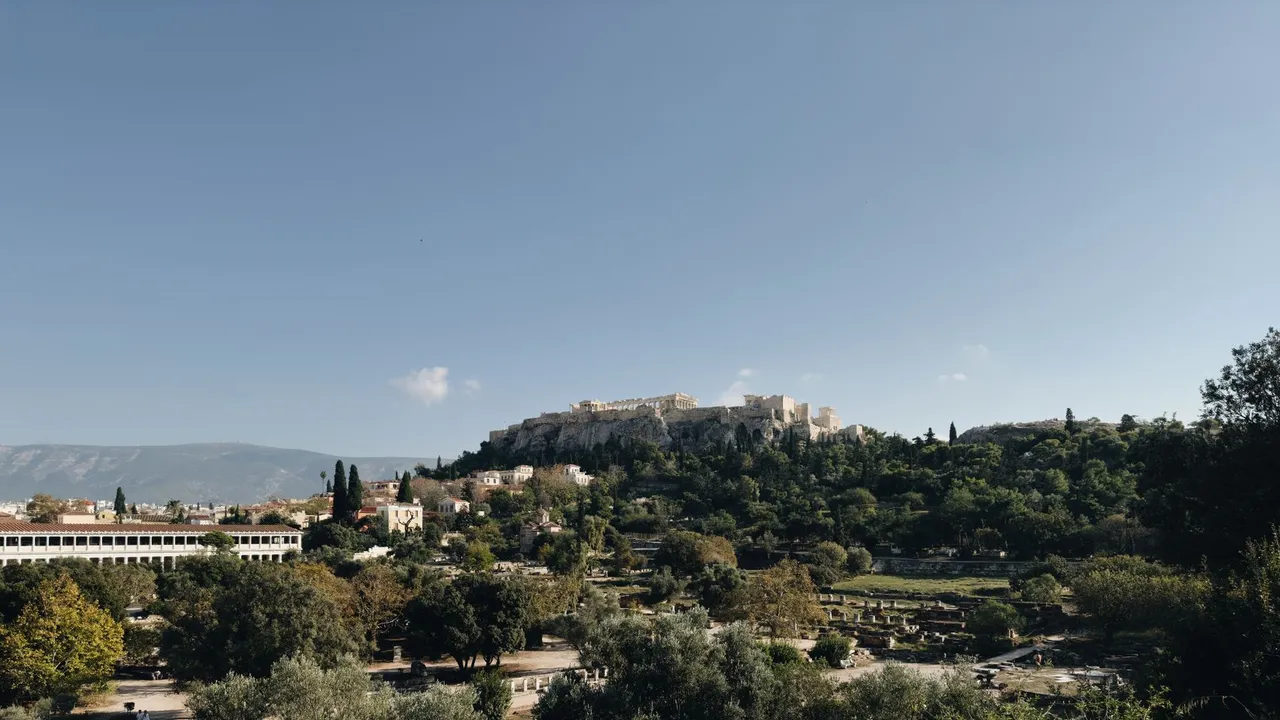
Take the metro from the airport into the centre. Climb the Acropolis early or late in the day to avoid the heat, seeing the Propylaea, the Parthenon and the Erechtheion with its caryatid porch. Then visit the Acropolis Museum at the foot of the hill, where the originals of many sculptures are kept. Spend the evening in the lanes of Plaka and Anafiotika below the rock.
Signal Vodafone and Nova both have 5G across central Athens; reception is good on the Acropolis itself, though it slows when the site is crowded.
-
Day 2 Athens
Ancient Agora and the National Archaeological Museum
Walk the Ancient Agora, where the Temple of Hephaestus stands almost intact, and the reconstructed Stoa of Attalos. Continue through Monastiraki to the Roman Agora. After lunch, spend two or three hours in the National Archaeological Museum, home to the Mask of Agamemnon and the Antikythera mechanism. End with sunset from Lycabettus Hill, reached by funicular from Kolonaki.
Signal Strong 4G and 5G above ground; the Athens metro has coverage in stations and most tunnels, so you can stay connected between sights.
-
Day 3 Athens
Day trip to Delphi
Delphi is about 2.5 hours from Athens by car or KTEL bus; organised day tours also run daily.
Travel to Delphi on the slopes of Mount Parnassus, the ancient sanctuary of Apollo and a UNESCO site. Walk the Sacred Way past the treasuries to the Temple of Apollo, the theatre and the stadium above, then visit the museum for the bronze Charioteer. Below the road, see the circular Tholos at the sanctuary of Athena Pronaia before heading back.
Signal Coverage is good in Delphi village and at the site entrance; it weakens on the mountain road through Arachova and in the upper reaches of the stadium.
-
Day 4 Naxos
Ferry to Naxos
Piraeus to Naxos takes about 3.5 hours by high-speed ferry or 5 to 6 hours on a conventional ferry; book ahead in summer.
Take a morning ferry from Piraeus to Naxos, the largest of the Cyclades. In the afternoon, walk out to the Portara, the huge marble doorway of an unfinished temple of Apollo on the islet joined to the harbour. Explore the Kastro, the Venetian quarter at the top of Naxos town, then watch the sunset from the Portara or the beach at Agios Georgios.
Signal Expect signal to drop in and out at sea between islands, with 4G returning near Syros or Paros and strong again in Naxos town.
-
Day 5 Naxos
Inland Naxos: Halki, Apeiranthos and the Temple of Demeter
Naxos town to Apeiranthos is about 45 minutes by car.
Hire a car for the mountain villages. Stop at the restored Temple of Demeter near Sangri, then Halki, with its Byzantine churches and citron distillery, in the Tragaea valley. Continue to Apeiranthos, a marble-paved village on the slopes of Mount Zas. Return via the long sandy beaches of Plaka or Mikri Vigla on the west coast for a late swim.
Signal 4G is usable in the main villages, but expect gaps on the mountain roads below Mount Zas; download an offline map of Naxos first.
-
Day 6 Santorini
Santorini: Fira to Oia on the caldera rim
Naxos to Santorini takes about 1.5 to 2 hours by ferry; the port at Athinios is a 20-minute drive below Fira.
Take the morning ferry to Santorini. From Fira, walk the caldera-edge path north through Firostefani and Imerovigli to Oia, about 10 km with views down into the flooded volcanic crater. Arrive in Oia in time for sunset, though it is crowded; returning by bus or taxi to Fira afterwards takes some planning.
Signal Good 4G and 5G along the caldera rim; reception can be weaker in the bays below the cliffs and at the port of Athinios.
-
Day 7 Santorini
Akrotiri and departure
Akrotiri is about 25 minutes' drive from Fira; the airport is about 15 minutes from Fira.
Visit Akrotiri, the Bronze Age town buried by the volcanic eruption around 1600 BC, now under a protective roof. Afterwards, see the Red Beach from the viewpoint, staying back from the unstable cliffs, or swim at the black-sand beach of Perissa. Leave time to reach Santorini airport for your flight.
Signal Reliable 4G at Akrotiri and the airport; coverage on the southern beaches is generally good.
Staying connected on this route
- Save ferry tickets offline and check sailings the evening before; strong summer meltemi winds can delay or cancel crossings.
- Keep 112 emergency alerts enabled on your phone during the wildfire season, as they go to wherever your phone is.
- Download offline maps of Naxos and Santorini before the ferry, as signal drops at sea.
Itinerary sources · 4
- insights.opensignal.com Greece mobile network experience report, March 2026 – Opensignal
- whc.unesco.org Acropolis, Athens – UNESCO World Heritage Centre
- whc.unesco.org Archaeological Site of Delphi – UNESCO World Heritage Centre
- gov.uk Greece safety and security – GOV.UK
Information and verification
Each block below says what was checked and when. Anything we cannot date, we do not claim.
- Prices and plans
- Every price and allowance on this page is read from the live catalog, not typed in.
- Host networks
- The operator list comes from the network partner that carries this eSIM.
Transparent pricing
Greece eSIM prices
| Data | Price | Per day |
|---|---|---|
| Unlimited | $6.99 | $2.33/day |
| Data | Price | Per day |
|---|---|---|
| Unlimited | $10.99 | $2.20/day |
| Data | Price | Per day |
|---|---|---|
| Unlimited | $18.99 | $1.90/day |
| Data | Price | Per day |
|---|---|---|
| Unlimited | $97.99 | $1.63/day |
| Data | Price | Per day |
|---|---|---|
| Unlimited | $149.99 | $1.67/day |
Going to more than one country?
Regional plans that also cover Greece
Destinations
Popular eSIM destinations
Travel guides
Read before you go


Jul 31, 2026 | 7 minute read
