eSIM for Bulgaria 
Viasimo's Bulgaria eSIM starts at $1.29 for 500 MB over 1 day, running on A1, Vivacom, and Yettel with 4G LTE where available. Plans last 1 to 180 days, arrive by email in minutes and install from your phone's settings, with no app.
Works everywhere in Bulgaria
- Blagoevgrad
- Burgas
- Dobrich
- Gabrovo
- Haskovo
- Kardzhali
- Kyustendil
Duration







Unlimited data · 3 Days ×1
$6.99
Does my phone take an eSIM? Check now
Dial *#06# on your phone. If you see an EID number, your phone takes an eSIM. Most phones sold since 2019 do.
Not sure it works on your phone? Check compatibilityWhich networks does the Bulgaria eSIM use?
Host networks: A1 / Vivacom / Yettel
Your eSIM picks one automatically; you do not choose or switch between them.
- Data
- 500 MB – 50 GB or unlimited
- Validity
- 1–180 days
- Speed
- 4G LTE
- Hotspot / tethering
- Supported on most devices
- Activation
- Starts when you first connect in your destination
- Speed management
- Roughly 2-3 GB per day at full speed, sometimes less depending on the local carrier, then reduced
- Top-ups
- Add more data from your account, before the plan expires
- Text messages (SMS)
- Data only: use an app for verification codes
- Unused validity
- 180 days before it must be installed
How much data do you need?
The allowances below are our sizing recommendations, not measurements. The plan beside each one is the cheapest option on this page that covers it.
| You are | Plan for | Cheapest plan that covers it |
|---|---|---|
| LightMaps, messaging and the occasional lookup | About 1 GB a week | $1.591 GB, 7 days |
| TypicalMaps, social, photos and some browsing | About 3 to 7 GB a week | $4.595 GB, 30 days |
| HeavyVideo streaming, video calls and uploads | 10 GB a week or more | $8.0010 GB, 30 days |
| Working or sharingTethering a laptop, calls and cloud sync | 20 GB a week or more | $13.99Unlimited, 7 days |
eSIM, local SIM or roaming?
Charged per day
Your carrier roaming
Queue and plastic
A SIM at the airport
$1.29
Viasimo, one bundle
Only the Viasimo figure is a price: it comes from today’s live catalog. The other two rows are directional, not quoted rates.
Important to know
- This is a data-only eSIM. It carries no calls or SMS on its own number.
- Your existing number stays on your primary SIM, so calls and verification texts keep working.
- Your phone must support eSIM, and some carrier-locked phones cannot install one.
- Signal varies with location, terrain, congestion and your handset. Dense urban areas are consistently better served than remote ones.
- The eSIM selects a host network automatically. You cannot pick or switch between them.
- Unlimited plans run at full speed up to a fair-use limit, then continue at a reduced speed. Read the fair usage policy
Frequently asked questions
Does an eSIM work in Bulgaria?
Yes. Your Bulgaria eSIM connects automatically the moment you arrive, with no roaming fees and nothing to set up at the airport. The host networks it can use are A1, Vivacom, Yettel. Coverage runs on 4G LTE. There is no 5G on our host network in Bulgaria yet.
Do I get 5G in Bulgaria?
No. A1, Vivacom, Yettel do not yet offer 5G to visitors in Bulgaria, so your eSIM connects over 4G LTE or slower. Anyone claiming 5G for this destination is quoting a spec sheet, not the network you will actually get.
Which mobile network is best in Bulgaria?
It depends on what you need. Opensignal's January 2026 report found A1 the fastest, averaging about 114 Mbps, and the most consistent. Vivacom scored best for coverage, and Yettel had the most 5G time. The differences are small. This eSIM uses all three, A1, Vivacom and Yettel (formerly Telenor), on 4G, and picks the strongest wherever you are.
Is Telenor still a network in Bulgaria?
Not under that name. Telenor Bulgaria became Yettel in 2022. The network is the same, but the name on your phone will usually be Yettel. If our plan lists Telenor, it means the same network, and your phone can connect to it alongside A1 and Vivacom.
Can I pay for Sofia public transport with my phone?
Yes. Sofia's metro, buses, trams and trolleybuses accept contactless Visa, Mastercard and Maestro cards, including foreign ones, and cards in Apple Pay or Google Pay. Tap the same card or phone every time, because inspectors check by tapping your card or phone. Each person needs their own card. One fare covers changes within 30 minutes.
Does Bulgaria use the euro or the lev now?
The euro. Bulgaria adopted it on 1 January 2026 at a fixed rate of 1.95583 leva to the euro. Mandatory dual pricing ended on 8 August 2026, but you'll still find lev prices online and in older guides. Divide those by about 1.96 to get euros.
Will my Bulgaria eSIM work if I drive into Greece?
Not on a Bulgaria-only plan. Since Bulgaria joined Schengen fully in January 2025, there's no border stop at crossings such as Kulata–Promachonas, so your phone can switch to a Greek network without you noticing. For a day trip, switch the eSIM line off near the border or buy a plan that covers both countries.
How much data do I need for 7 days in Bulgaria?
For 7 days in Bulgaria, Viasimo sells 1 GB for $1.59 and unlimited data for $13.99. Our sizing recommendation, not a measurement: maps, messaging and the occasional lookup, about 1 GB a week; maps, social, photos and some browsing, about 3 to 7 GB a week. The data calculator on this site works it out from how you actually use your phone.
Installing, keeping your number, topping up and hotspot work the same everywhere: see how it works →
Bulgaria: what to know before you land
Bulgaria changed in two ways that matter for visitors. Since January 2025 there are no checks at its land borders with Greece and Romania, and since January 2026 it uses the euro. Your eSIM connects to all three national networks, A1, Vivacom and the former Telenor (now Yettel), on 4G, and Sofia's buses, trams and metro accept contactless cards and phones.
- Emergency
- 112
- Plugs
- CF 230V
- Currency
- Euro (EUR), since 1 January 2026
Main airports
- SOF Sofia Airport
- BOJ Burgas Airport
- VAR Varna Airport
- PDV Plovdiv Airport
A1, Yettel and Vivacom in Opensignal's 2026 results
Bulgaria's three mobile operators are closely matched. In Opensignal's January 2026 report, A1 came first for download speed, averaging about 114 Mbps against roughly 96 Mbps for Vivacom and 90 Mbps for Yettel. A1 also led for consistent quality. Vivacom had the best Coverage Experience score (7.5 out of 10, with A1 and Yettel both on 7.1), which gives it an advantage in rural areas and mountains. Yettel and A1 shared the video award.
Yettel is the former Telenor Bulgaria, which changed its name in 2022, so your phone may show it as Yettel rather than Telenor. Your eSIM can use all three networks, and your phone will move to whichever is strongest. That helps in the Rhodopes or on the Pirin approach roads, where one operator often reaches places the others don't.
Opensignal found that Bulgarian users spend more than 80% of their time on 5G with every operator. The eSIM plan for Bulgaria is 4G/LTE, so you won't see 5G, but 4G is fast enough for maps, messages and video calls in towns.
Prices in euros and leva during 2026
Bulgaria joined the eurozone on 1 January 2026. The lev was converted at a fixed rate of 1.95583 to the euro, and shops had to show prices in both currencies from 8 August 2025 to 8 August 2026, so some menus and price tags still carry both.
The practical effect is on your phone. Older reviews, blog posts, booking confirmations and some transport websites still give prices in leva. To convert, divide by about 1.96, which roughly halves the number. A taxi fare of 20 leva is about €10.
Card payments are now in euros, and you won't need to convert currency, so you won't be offered a lev exchange rate at a card terminal. Check the bill if a restaurant or guesthouse quotes you in leva. It's also worth checking that any banking app alerts on your phone show the expected euro amount.
Tapping in on Sofia's buses, trams and metro
In Sofia you don't need a transport app or a paper ticket. Every bus, tram, trolleybus, suburban bus and metro line accepts contactless Visa, Mastercard and Maestro cards, including cards issued abroad, and cards stored in Apple Pay or Google Pay. On surface transport, tap the reader on board. In the metro, tap the screen at the turnstile. One fare covers transfers within 30 minutes, and the charge for the day is worked out automatically.
There are a few rules:
- Use the same card or phone for every journey, or the system can't group your trips correctly.
- One card covers one person, so each traveller needs their own.
- Ticket inspectors check by tapping the card or phone you used, so keep your phone charged. A flat battery means you can't show you've paid.
The metro runs from Terminal 2 at Sofia Airport into the city centre, so you can tap in on the platform as soon as you land.
Driving into Greece or Romania with no border stop
Bulgaria and Romania became full members of the Schengen area on 1 January 2025, and checks were removed at their internal land borders. You can now drive from Bulgaria into Greece at Kulata–Promachonas or cross the Danube bridge from Ruse to Giurgiu in Romania without stopping.
That's convenient, but it makes it easier to miss the border. Your phone will switch to a Greek or Romanian network a few kilometres before you notice anything, and a Bulgaria-only plan won't work there. Near the borders, for example around Kulata, Ruse or the Rhodopes passes into Greece, keep an eye on your network name. If you're crossing for a day trip, switch the eSIM line off or buy a plan that covers both countries.
The borders with Turkey, Serbia and North Macedonia are outside Schengen, so passport checks still apply at crossings such as Kapitan Andreevo on the Turkish border. Download offline maps and screenshot any bookings before you join the queue.
Researched October 2026 · 5 sources
- insights.opensignal.com Bulgaria, January 2026, Mobile Network Experience (Opensignal)
- economic.bg It's official: Bulgaria will become the 21st member of the eurozone on January 1, 2026
- dskbank.bg Public transport contactless payments in Sofia (DSK Bank)
- eucrim.eu Bulgaria and Romania fully join Schengen (eucrim)
- nfcw.com Sofia rolls out open loop contactless ticketing on public transport network
Seven days in Bulgaria: Sofia, Rila, Plovdiv, the Rose Valley and Veliko Tarnovo
A first week in Bulgaria's interior for history and mountain scenery: Sofia and Rila Monastery, Roman and Ottoman Plovdiv, the Thracian tombs and Shipka Pass, then the medieval capital Veliko Tarnovo before returning to Sofia.
When to go May to June and September to October are best: the Rose Valley harvest runs from late May to early June, summer is hot in Plovdiv, and Rila and the Shipka Pass can see snow from November to March.
-
Day 1 Sofia
Sofia: cathedrals and Roman Serdica
The metro runs from Terminal 2 at Sofia Airport to the centre in about 20 minutes; tap in with a contactless card or phone.
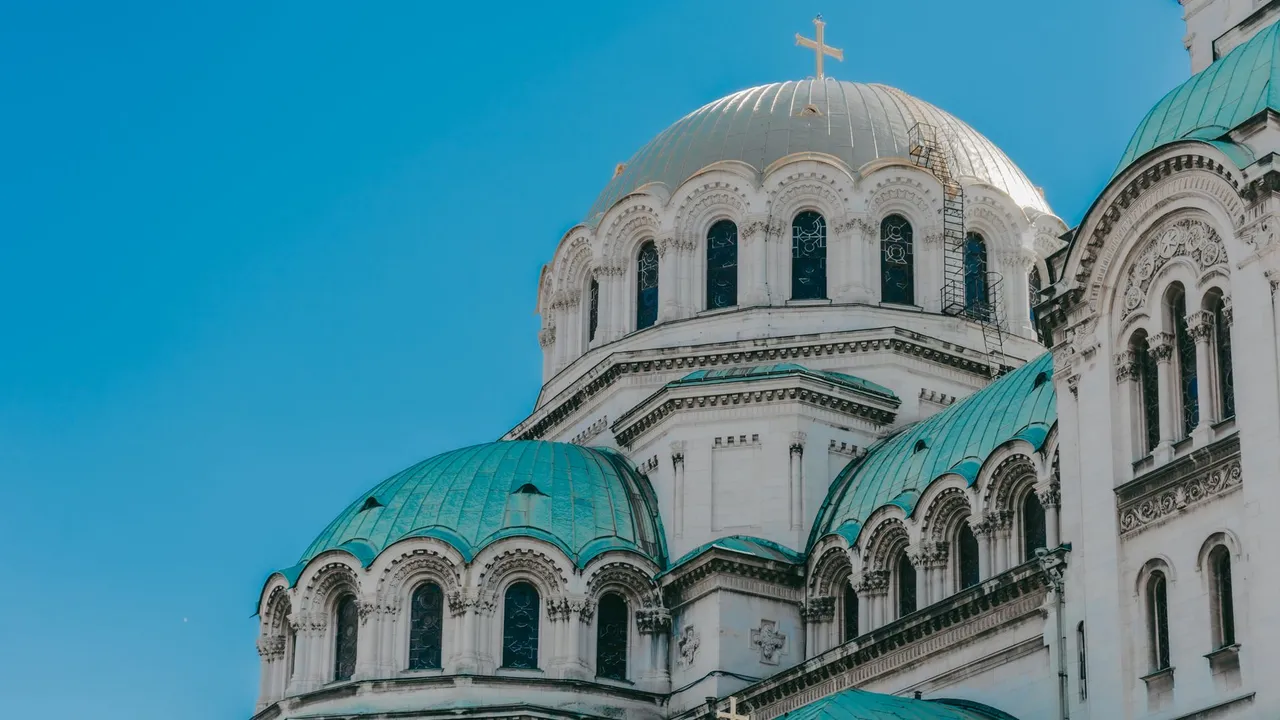
Start at the Alexander Nevsky Cathedral and the icon collection in the crypt nearby. Walk past the small Russian Church to the Rotunda of St George, hidden in a courtyard behind the presidency, and the excavated streets of Roman Serdica in the Largo underpass. See the Banya Bashi Mosque and the Central Mineral Baths, then finish along Vitosha Boulevard with the mountain at its far end.
Signal Strong 4G across central Sofia on A1, Vivacom and Yettel, and the metro has coverage in its stations. Keep your phone charged: ticket inspectors check the card or phone you tapped.
-
Day 2 Sofia
Rila Monastery
Rila Monastery is about 120 km from Sofia; allow 2 to 2 hours 30 minutes each way by car or on an organised day tour. Public buses run but are infrequent.
Day trip south into the Rila Mountains to Rila Monastery, founded in the 10th century and rebuilt in the 19th, and a UNESCO World Heritage Site. See the frescoed Church of the Nativity, Hrelyo's Tower from the 14th century and the monastery museum. If you have time, walk up the forest trail to the cave of St Ivan of Rila, about 40 minutes each way. Dress with shoulders and knees covered.
Signal 4G on the motorway south, becoming patchy in the Rilska valley. Around the monastery you will usually have some data, Vivacom often strongest, but on the forest trails it can disappear.
-
Day 3 Plovdiv
Plovdiv: the Old Town and the Roman theatre
Sofia to Plovdiv takes about 2 hours by bus or 2 hours 30 minutes to 3 hours by train.
Travel to Plovdiv and start at the Roman Stadium under the main pedestrian street. Climb into the Old Town on its three hills to see the Ancient Theatre, still used for summer performances, and the 19th-century merchants' houses, including the Ethnographic Museum. Walk up Nebet Tepe for the view across the city, then spend the evening in Kapana, the former craftsmen's quarter of narrow streets.
Signal Good 4G on the motorway and throughout Plovdiv, including the Old Town hills.
-
Day 4 Plovdiv
Bachkovo Monastery and Asen's Fortress
Bachkovo is about 30 km south of Plovdiv, roughly 40 minutes by car or local bus via Asenovgrad.
Head south into the Rhodope foothills to Bachkovo Monastery, Bulgaria's second-largest, founded in 1083, with an old frescoed refectory and Zahari Zograf's 19th-century paintings in the Archangels' Church. Continue a few kilometres to Asen's Fortress above Asenovgrad, where a 13th-century church stands on a crag over the Chepelarska gorge. Return to Plovdiv for the afternoon and visit the Regional Archaeological Museum.
Signal 4G in Asenovgrad; the gorge road and the monastery have a weaker signal, with one network usually reaching where others do not.
-
Day 5 Veliko Tarnovo
Kazanlak, the Rose Valley and Shipka Pass
Plovdiv to Kazanlak is about 1 hour 30 minutes by car, and Kazanlak to Veliko Tarnovo over the Shipka Pass about 2 hours. Without a car, buses link the towns but you will need to skip the pass.
Drive north-east to Kazanlak in the Valley of the Roses. See the full-size replica of the UNESCO-listed Thracian Tomb of Kazanlak beside the sealed original, and the Rose Museum. Continue to the gold-domed Shipka Memorial Church, then up to the Shipka Pass and climb the steps to the Freedom Monument at the top. Descend the north side of the Balkan Mountains to Veliko Tarnovo.
Signal 4G in Kazanlak and on the main roads. On the Shipka Pass hairpins the signal drops in places, but the summit monument usually has coverage.
-
Day 6 Veliko Tarnovo
Veliko Tarnovo and Arbanasi
Arbanasi is 4 km from Veliko Tarnovo, about 10 minutes by taxi.
Spend the morning on Tsarevets Hill, the walled citadel of the Second Bulgarian Empire, and the Patriarchal Cathedral at its top. Walk down through the old town, browse the craft workshops of Samovodska Charshia, and look across the Yantra River loops from the Asenevtsi monument. In the afternoon, take a short taxi ride to Arbanasi to see the frescoed Nativity Church and its old stone houses.
Signal Reliable 4G in Veliko Tarnovo and Arbanasi. Signal can drop in the deep river bends below the town.
-
Day 7 Sofia
Back to Sofia and Boyana Church
Veliko Tarnovo to Sofia is about 3 hours by bus or 4 to 5 hours by train with a change.
Travel back to Sofia in the morning. In the afternoon, take a taxi to the foot of Vitosha to see Boyana Church, a UNESCO-listed medieval church with frescoes from 1259; visits are timed and limited in number. Then visit the National Museum of History nearby for the Thracian gold treasures, or ride a cable car or bus up Vitosha for an evening view of the city.
Signal 4G on the bus route with brief gaps through the Balkan foothills. Sofia and the Boyana area have strong coverage; it thins higher up on Vitosha.
Staying connected on this route
- Your eSIM can use A1, Vivacom and Yettel, the former Telenor; in the Rila and Rhodope valleys switch network manually if data stalls.
- Download offline maps of the Rila valley and the Shipka Pass before you set off.
- This route stays inside Bulgaria, but near the Greek or Romanian borders your phone can switch to a foreign network without any border stop, so watch the network name.
- Use the same card or phone for every Sofia transport tap, and keep it charged for inspections.
Itinerary sources · 6
- whc.unesco.org UNESCO World Heritage: Rila Monastery
- whc.unesco.org UNESCO World Heritage: Boyana Church
- whc.unesco.org UNESCO World Heritage: Thracian Tomb of Kazanlak
- insights.opensignal.com Opensignal: Bulgaria mobile network experience, January 2026
- dskbank.bg DSK Bank: contactless payments on Sofia public transport
- en.wikipedia.org Bachkovo Monastery – Wikipedia
Information and verification
Each block below says what was checked and when. Anything we cannot date, we do not claim.
- Prices and plans
- Every price and allowance on this page is read from the live catalog, not typed in.
- Host networks
- The operator list comes from the network partner that carries this eSIM.
Bulgaria eSIM prices
| Data | Price | Per day |
|---|---|---|
| Unlimited | $6.99 | $2.33/day |
| Data | Price | Per day |
|---|---|---|
| Unlimited | $10.99 | $2.20/day |
| Data | Price | Per day |
|---|---|---|
| Unlimited | $18.99 | $1.90/day |
| Data | Price | Per day |
|---|---|---|
| Unlimited | $97.99 | $1.63/day |
| Data | Price | Per day |
|---|---|---|
| Unlimited | $149.99 | $1.67/day |
Going to more than one country?
Regional plans that also cover Bulgaria



Destinations