eSIM for Slovenia 
Viasimo's Slovenia eSIM starts at $1.29 for 500 MB over 1 day, running on Mobitel and Telemach with 5G where available. Plans last 1 to 180 days, arrive by email in minutes and install from your phone's settings, with no app.
Works everywhere in Slovenia
- Destrnik
- Dobrna
- Dol pri Ljubljani
- Dolenjske Toplice
- Gorje
- Grad
- Hajdina
Duration


Unlimited data · 3 Days ×1
$6.99
Does my phone take an eSIM? Check now
Dial *#06# on your phone. If you see an EID number, your phone takes an eSIM. Most phones sold since 2019 do.
Not sure it works on your phone? Check compatibilityWhich networks does the Slovenia eSIM use?
Host networks: Mobitel / Telemach
Your eSIM picks one automatically; you do not choose or switch between them.
- Data
- 500 MB – 50 GB or unlimited
- Validity
- 1–180 days
- Speed
- 4G LTE / 5G
- Hotspot / tethering
- Supported on most devices
- Activation
- Starts when you first connect in your destination
- Speed management
- Roughly 2-3 GB per day at full speed, sometimes less depending on the local carrier, then reduced
- Top-ups
- Add more data from your account, before the plan expires
- Text messages (SMS)
- Data only: use an app for verification codes
- Unused validity
- 180 days before it must be installed
How much data do you need?
The allowances below are our sizing recommendations, not measurements. The plan beside each one is the cheapest option on this page that covers it.
| You are | Plan for | Cheapest plan that covers it |
|---|---|---|
| LightMaps, messaging and the occasional lookup | About 1 GB a week | $1.591 GB, 7 days |
| TypicalMaps, social, photos and some browsing | About 3 to 7 GB a week | $4.595 GB, 30 days |
| HeavyVideo streaming, video calls and uploads | 10 GB a week or more | $8.0010 GB, 30 days |
| Working or sharingTethering a laptop, calls and cloud sync | 20 GB a week or more | $13.99Unlimited, 7 days |
eSIM, local SIM or roaming?
Charged per day
Your carrier roaming
Queue and plastic
A SIM at the airport
$1.29
Viasimo, one bundle
Only the Viasimo figure is a price: it comes from today’s live catalog. The other two rows are directional, not quoted rates.
Important to know
- This is a data-only eSIM. It carries no calls or SMS on its own number.
- Your existing number stays on your primary SIM, so calls and verification texts keep working.
- Your phone must support eSIM, and some carrier-locked phones cannot install one.
- Signal varies with location, terrain, congestion and your handset. Dense urban areas are consistently better served than remote ones.
- 5G only works where the host network has deployed it and your phone supports it. Everywhere else it falls back to 4G LTE.
- The eSIM selects a host network automatically. You cannot pick or switch between them.
- Unlimited plans run at full speed up to a fair-use limit, then continue at a reduced speed. Read the fair usage policy
Frequently asked questions
Does an eSIM work in Slovenia?
Yes. Your Slovenia eSIM connects automatically the moment you arrive, with no roaming fees and nothing to set up at the airport. The host networks it can use are Mobitel, Telemach. Coverage runs on 4G LTE and 5G where the network has rolled it out, and falls back to 4G elsewhere.
Do I get 5G in Slovenia?
Yes, where it has been deployed. 5G runs on Mobitel, Telemach in Slovenia, and your eSIM uses it automatically on a 5G-capable phone, dropping back to 4G LTE outside covered areas. No country is covered everywhere, so 5G availability varies by location.
Do I need winter tyres to drive in Slovenia?
Yes, from 15 November to 15 March and whenever winter conditions occur. Cars up to 3.5 tonnes need winter tyres on all four wheels, or summer tyres plus snow chains, with at least 3 mm of tread. The UK Foreign Office lists fines of €125, or €417 if your car causes delays. Check your hire car before leaving the depot.
What number do I call for mountain rescue in Slovenia?
Call 112, which covers mountain rescue as well as ambulance and fire; the police are on 113. Our eSIM is data only, so call from your home SIM or another phone. Before a hike in Triglav National Park, share your route and return time, since deep valleys often have no signal.
Can I use my phone while driving in Slovenia?
Only hands-free. The UK Foreign Office warns that using a mobile phone while driving without a wireless headset can lead to an on-the-spot fine. Mount your phone and set your navigation before setting off. Headlights must also be on at all times, and you must carry a warning triangle, reflective jacket and first-aid kit.
Are there bears in Slovenia's mountains?
Yes. The UK Foreign Office says bears and wolves are occasionally encountered in mountain areas and advises extra care where bears have been seen. Ask locally about recent sightings, stay on marked paths and avoid shortcuts or closed trails. Download offline hiking maps before you set off, as forest and valley sections can lose signal.
How much data do I need for 7 days in Slovenia?
For 7 days in Slovenia, Viasimo sells 1 GB for $1.59 and unlimited data for $13.99. Our sizing recommendation, not a measurement: maps, messaging and the occasional lookup, about 1 GB a week; maps, social, photos and some browsing, about 3 to 7 GB a week. The data calculator on this site works it out from how you actually use your phone.
Installing, keeping your number, topping up and hotspot work the same everywhere: see how it works →
Slovenia: what to know before you land
Our eSIM in Slovenia can use both Mobitel, the brand of Telekom Slovenije, and Telemach, including 5G where available. Most of what you will look up concerns the roads and mountains: winter tyre rules from mid-November, headlights on at all times, fines for handheld phone use while driving, and sudden storms in the Julian Alps. For mountain rescue, call 112.
- Emergency
-
- 112 ambulance, fire, mountain rescue
- 113 police
- Plugs
- CF 230V
- Currency
- Euro (EUR)
Main airports
- LJU Ljubljana Jože Pučnik Airport
Winter tyres, headlights and phone fines on Slovenian roads
Slovenia's motorway e-vignette gets most of the attention, but the other driving rules are just as strictly enforced. From the UK Foreign Office's guidance:
- Winter equipment is compulsory from 15 November to 15 March, and at any other time winter conditions occur. Cars up to 3.5 tonnes need winter tyres on all four wheels, or summer tyres plus snow chains, with at least 3 mm of tread. Fines are €125, rising to €417 if your car holds up traffic. Check your hire car has the right tyres when you collect it.
- Headlights must be on at all times, day and night. Carry a warning triangle, reflective jacket and first-aid kit.
- Using a phone while driving without a hands-free kit can bring an on-the-spot fine. Mount it and set your route before you set off.
- The drink-drive limit is 0.05%, and zero for drivers under 21 or with less than two years' experience.
If you break down, call 1970 or +386 1 518 8 518 and use only recovery firms showing the DARS logo. Vehicles over 3.5 tonnes, including some large campervans, must also register with the DarsGo tolling system rather than using a vignette.
Our eSIM is data only, so breakdown and emergency calls go through your home SIM, which works in Slovenia under your own operator's roaming terms.
Storms, flash floods and ARSO forecasts in the Julian Alps
Slovenia's weather can turn fast. The UK Foreign Office warns that sudden, extreme storms can hit any part of the country, bringing snow, lightning, hail and landslides, and that flash floods can arrive with little warning. If you are caught in a storm, shelter until it passes rather than pushing on.
For forecasts, the FCDO points to the national meteorological service ARSO and the English-language pages of Meteoalarm, which shows official weather warnings by region. Both are worth checking on your phone every morning before a hike, a canyoning or rafting trip on the Soča, or a drive over a mountain pass, and again before committing to an exposed section.
In winter, off-piste skiing carries an avalanche risk in some areas. Stick to marked runs unless you are with a qualified guide.
For emergencies in the mountains, 112 covers ambulance, fire and mountain rescue; the police are on 113. Before you lose signal in a valley, send your planned route and expected return time to someone, and keep a power bank with you, because a phone used for navigation and photos drains quickly in the cold.
Bears, via ferratas and mountain huts in Triglav National Park
Slovenia's mountains are well marked and busy in summer, but the UK Foreign Office lists a few hazards that surprise visitors.
Bears and wolves are occasionally encountered in mountain and forest areas, and you should take extra care where bears have been reported. Ask at your accommodation or local tourist office about recent sightings before walking in the forests of the south and the Alps.
Some mountain trails include via ferrata sections with fixed cables and ladders, which need a climbing harness, lanyard and helmet. Check route descriptions carefully; a trail that looks like a hike on a map app may include exposed protected sections.
The FCDO's other advice is practical:
- Choose routes for the least fit member of your group.
- Carry a printed or digital map of marked paths; download offline maps and hiking maps before you leave town, as deep valleys lose signal.
- Check that the mountain huts you plan to use are open, as many operate seasonally, and book beds in advance in summer.
- Do not use closed trails or take shortcuts.
On the way up, a ridge or hut terrace often has signal when the valley below does not. Use those spots to check the weather and update anyone waiting for you.
Researched October 2026 · 4 sources
- gov.uk Slovenia travel advice: safety and security - GOV.UK
- gov.uk Slovenia travel advice: getting help - GOV.UK
- en.wikipedia.org Telekom Slovenije - Wikipedia
- royalbrinkman.com Voltage, frequency and plug type per country - Royal Brinkman
Seven days in Slovenia: Ljubljana, Bled, Bohinj, the Soča valley, the Karst and Piran
A compact driving loop for walkers and lake lovers: Ljubljana's old town, Lake Bled and Bohinj in the Julian Alps, over the Vršič Pass into the emerald Soča valley, then south to the Škocjan Caves and the Venetian-era coast at Piran.
When to go Late May to September is the best window, as the Vršič Pass is usually closed to traffic in winter and some gorges shut from late autumn; June and September avoid the August crowds at Bled, and sudden summer storms are common in the Alps.
-
Day 1 Ljubljana
Ljubljana: the old town and the castle
Ljubljana Jože Pučnik Airport is about 25–30 minutes from the centre by road.
Start at Prešeren Square and cross Jože Plečnik's Triple Bridge into the old town. Walk through the Central Market along the river, past the Dragon Bridge, then take the funicular up to Ljubljana Castle for the view over the red roofs to the Kamnik Alps. In the evening stroll the riverside terraces of the Ljubljanica.
Signal Mobitel and Telemach 5G are both widely available across central Ljubljana, and this eSIM can use either. Coverage is solid in the castle and on the funicular.
-
Day 2 Bled
Lake Bled and the Vintgar Gorge
Ljubljana to Bled, about 45 minutes to an hour by motorway; buy the e-vignette before you drive.
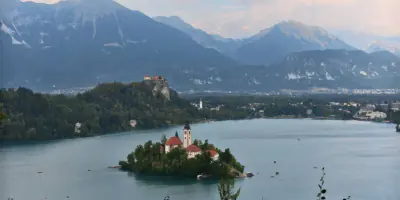
Drive north-west to Bled. Walk the 6 km path around the lake, then take a pletna rowing boat out to the island and climb the steps to the Church of the Assumption. In the afternoon go up to Bled Castle on its cliff above the water. From spring to autumn, add the Vintgar Gorge, a one-way boardwalk along the Radovna river, booked in advance online.
Signal Strong 4G and 5G around Lake Bled and in the town. Signal can be weaker deep in the Vintgar Gorge, so have your ticket saved offline.
-
Day 3 Bled
Lake Bohinj and Savica waterfall
Bled to Lake Bohinj, about 30–40 minutes by road.
Drive to Lake Bohinj inside Triglav National Park. Visit the Church of St John the Baptist by the stone bridge at Ribčev Laz, then drive to the end of the lake and climb the steps to the Savica waterfall. Take the Vogel cable car up for the view across the lake to Triglav, Slovenia's highest peak, on a clear afternoon, before driving back to Bled.
Signal Coverage is good around Ribčev Laz and the lake, weaker on the path to Savica and patchy on some trails from the top of Vogel. Check ARSO forecasts before going high.
-
Day 4 Bovec
Over the Vršič Pass to Bovec
Bled to Bovec over Vršič, roughly 2.5–3 hours with stops; the pass is usually closed to traffic in winter.
Drive via Kranjska Gora and climb the Vršič Pass, the highest road pass in Slovenia, on its cobbled hairpin bends. Stop at the wooden Russian Chapel, built in memory of the Russian prisoners of war who died building the road. Descend into the Trenta valley, follow the Soča to Bovec, and walk to the Great Soča Gorge on the way.
Signal Signal drops on the upper hairpins of Vršič and in parts of the Trenta valley. 4G returns in Bovec; mount your phone before driving, as handheld use is fined.
-
Day 5 Kobarid
The Soča valley: Kobarid and Kozjak
Bovec to Kobarid, about 30 minutes by road.
Spend the morning on the river: book rafting or kayaking in Bovec with a licensed operator, or walk a section of the Soča Trail. In the afternoon drive to Kobarid and visit the Kobarid Museum, which tells the story of the First World War Isonzo front fought in these mountains. Finish with the short walk to Kozjak waterfall, inside a dark rock chamber.
Signal 4G works in Bovec and Kobarid, but expect dead spots in the gorge sections of the Soča and at Kozjak. Leave your plans with your accommodation before river trips.
-
Day 6 Piran
The Karst: Škocjan Caves
Kobarid to Škocjan, roughly 1.5–2 hours; Škocjan to Piran about 45 minutes.
Drive south to the Karst plateau and take a guided tour of the Škocjan Caves, a UNESCO site where the Reka river has carved a vast underground canyon crossed by a high footbridge. Book tickets online, as tours sell out in summer, and bring a jacket for the cool air underground. Continue to the coast and arrive in Piran for the evening.
Signal There is no signal inside the caves. Coverage is good at the visitor centre and on the motorway to the coast, and strong in Piran.
-
Day 7 Ljubljana
Piran, then back to Ljubljana
Piran to Ljubljana, about 1.5 hours by motorway.
Spend the morning in Piran, the walled Venetian-era town on a narrow peninsula. Start in Tartini Square, climb to the Church of St George for the view over the Adriatic, then walk along the town walls above the old town. Drive back to Ljubljana in the afternoon for your flight or a final evening by the river.
Signal Strong 4G and 5G in Piran and along the motorway; near the coast your phone may briefly see Italian or Croatian networks, so check it stays on a Slovenian one.
Staying connected on this route
- Buy Slovenia's motorway e-vignette online before you drive, and keep the confirmation saved offline.
- Check ARSO and Meteoalarm each morning in the Alps; storms build quickly on summer afternoons.
- Download offline maps for Triglav National Park, Vršič and the Soča valley, where deep valleys lose signal.
- Book Vintgar and Škocjan tickets online in advance and save them to your phone.
Itinerary sources · 4
- vintgar.si Vintgar Gorge
- park-skocjanske-jame.si Škocjan Caves Park
- whc.unesco.org UNESCO: Škocjan Caves
- gov.uk GOV.UK foreign travel advice: Slovenia
Information and verification
Each block below says what was checked and when. Anything we cannot date, we do not claim.
- Prices and plans
- Every price and allowance on this page is read from the live catalog, not typed in.
- Host networks
- The operator list comes from the network partner that carries this eSIM.
Slovenia eSIM prices
| Data | Price | Per day |
|---|---|---|
| Unlimited | $6.99 | $2.33/day |
| Data | Price | Per day |
|---|---|---|
| Unlimited | $10.99 | $2.20/day |
| Data | Price | Per day |
|---|---|---|
| Unlimited | $18.99 | $1.90/day |
| Data | Price | Per day |
|---|---|---|
| 3 GBBest value | $3.29 | $0.11/day |
| 5 GB | $4.59 | $0.15/day |
| 10 GB | $8.00 | $0.27/day |
| 20 GB | $14.99 | $0.50/day |
| Unlimited | $50.00 | $1.67/day |
| Data | Price | Per day |
|---|---|---|
| Unlimited | $97.99 | $1.63/day |
| Data | Price | Per day |
|---|---|---|
| Unlimited | $149.99 | $1.67/day |
Going to more than one country?
Regional plans that also cover Slovenia



Destinations